Editor
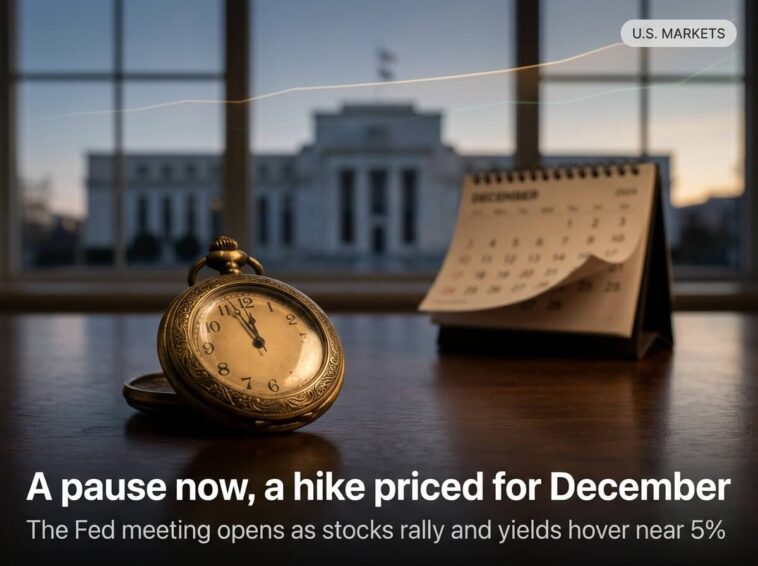
Fed Meeting Opens With Stocks Rallying, Yields Near 5%, and a December Hike Already Priced In
The Fed meeting began Tuesday, and nobody expects a surprise. That’s the surprise.
Policymakers gather for two days, with the decision due Wednesday at 2 p.m. Eastern and Chair Kevin Warsh’s press conference at 2:30. Futures put the odds of a hold near 90%. A Reuters poll found 94 of 100 economists expect rates to stay at 3.75% to 4%. And all 100 expect a hike in December.
Read that again. The Fed is expected to do nothing, and then do something.
Wall Street didn’t flinch. Monday’s rally carried over. The S&P 500 closed Monday up 0.70% at 7,676.77, the Nasdaq Composite gained 0.82% to 26,169.38, and the Dow rose 0.28% to 52,361.58. The VIX fell 5.5% to 18.39. By Tuesday midday, the S&P 500 was up about 0.7% near 7,729, the Nasdaq had added more than 1%, and 57 of 60 stocks in a Yahoo Finance chip basket were rising. AI and chip shares had been lifted by Anthropic’s IPO filing, and oil slipped again.
Why This Fed Meeting Is Really About December
October is the warm-up act.
The Fed raised rates 25 basis points in September, its first hike in more than three years, with unanimous support. Warsh said then that inflation is too high and has been for too long. Since that meeting, the numbers have gotten worse. September consumer prices rose 3.7% from a year earlier, and wholesale prices jumped 6.3%.
Normally, that screams “hike now.” For a few days it did. Odds of an October increase jumped sharply after the hot consumer report. Then Vice Chairs Philip Jefferson and Michelle Bowman, Governor Chris Waller and New York Fed President John Williams each signaled there’s no particular hurry. Pricing swung back. As of Tuesday, an October hike sat near 10%, while a December hike hovered around 80%, down from a peak near 90%.
So the real story is tone. Warsh kept his last press conference to about half an hour, brief compared with his predecessor Jerome Powell, and he isn’t a fan of forward guidance. A single phrase could move yields.
“The statement will be short, and the press conference decides everything,” said Gavin Holloway, head of rates strategy at a New York boutique firm. “If Warsh says further tightening is likely needed, December becomes a lock and long yields push back above 5%. If he sounds patient, you’ll see a relief rally. He’s unlikely to hand anyone a clear script.”
What the Yield Curve Is Saying
Now look at the bond market, because it already placed its bet.
The 10-year Treasury yield sat near 5.00% Tuesday. The 30-year was around 5.30%. The 2-year yield stood at about 4.72%, well above the top of the Fed’s current range. When two-year yields run that far above the policy rate, traders are betting the Fed will raise rates, and soon.
The 10-year hit 5.36% earlier this month, its highest intraday level since 2002, and has since eased. Short-term Treasuries now pay solid yields too: roughly 4.14% on a three-month bill, 4.36% on a six-month and 4.46% on a one-year.
That’s the heart of the matter for ordinary savers. Cash in a bill now earns more than the Fed’s own target rate, because markets expect more hikes.
Higher yields also squeeze borrowers. Mortgage rates, car loans and business credit all track longer-term yields, not the overnight rate the Fed sets. So even a pause this week leaves tight money in place.
The Counter-Narrative: A December Hike Would Be a Mistake
Not everyone agrees the Fed should follow through.
“Energy is doing most of the damage here, and you can’t fix an oil shock with higher interest rates,” said Maya Linden, chief U.S. economist at a Chicago consulting firm. “Core inflation is running far below the headline. Hiring is soft. If the Fed hikes in December into $100 oil and a cooling job market, it risks tipping a slowdown into something worse. I’d wait.”
Her case has support. The central bank has signaled it doesn’t want to raise rates at every meeting. And the 10-year yield has already fallen back from 5.36%. Markets can tighten policy on their own.
But there’s a catch. Inflation has run above the Fed’s 2% target for more than five years, and officials rarely like to look soft after a string of hot reports.
What Retail Investors Should Do Now
None of this is personal advice. It’s a checklist.
First, don’t trade the press conference. Warsh may say one thing at 2:30 and something different in the Q&A. Prices can whipsaw within minutes. A plan made today beats a panic made Wednesday.
Second, look at short-term Treasuries and money market funds. Bills yielding more than 4% carry little price risk and roll into higher rates if the Fed hikes. For money you may need within a year or two, that’s worth a serious look. Check current rates before you buy.
Third, know your debt. If you carry a variable-rate loan or credit card balance, a December hike makes it costlier. Paying it down can beat almost any investment return.
Fourth, understand which stocks suffer when yields climb. Utilities, real estate and homebuilders tend to struggle, because they carry heavy debt or depend on cheap mortgages. Banks usually hold up better. That doesn’t mean sell. It means know your exposure.
Fifth, keep an eye on Thursday’s inflation data and this week’s earnings from Microsoft, Alphabet and Amazon. Spending plans for AI could swing the Nasdaq as much as the Fed.
What Comes Next
Wednesday’s decision will probably be quiet. The hint inside it won’t be.
The Fed’s stance? Patient, yet poised. The market’s stance? Already leaning toward December. The only real question is whether Warsh confirms it.