Editor
SpaceX Stock Surges on a Blowout Quarter and Merger Talk, While Netflix Stumbles on Weak Ad Guidance
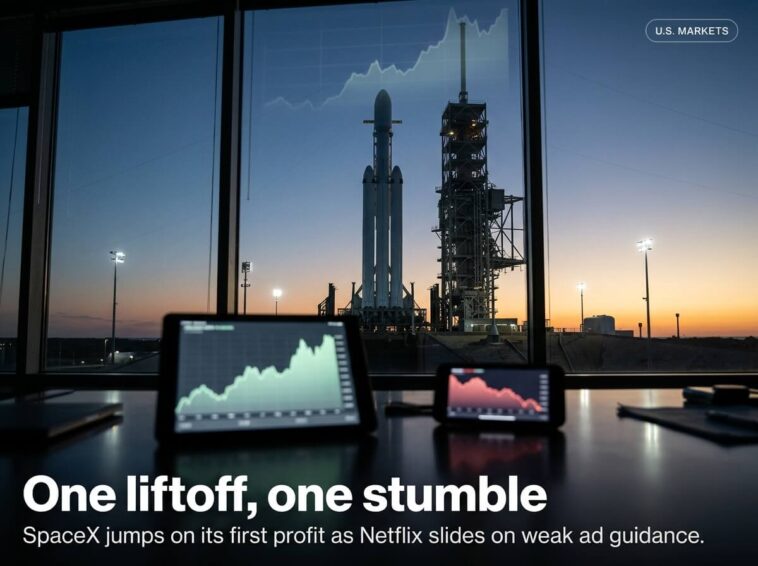
SpaceX stock jumped about 9% in premarket trading Wednesday, and the AI trade got a pulse. Netflix got the opposite treatment.
Two earnings reports landed after Tuesday’s closing bell. They pointed in opposite directions. SpaceX reported third-quarter revenue of $14.58 billion, far above the roughly $12.7 billion analysts expected. Earnings came in at 35 cents a share, well above estimates near 15 cents, and the company posted its first profit as a public company. Revenue grew 161% from a year earlier.
Netflix beat on profit and missed on the future. Revenue rose 12% to $12.87 billion and earnings hit 87 cents, topping the 82 cents Wall Street wanted. But the streamer cut its ad sales guidance, and the stock dropped more than 6% before the open.
Futures were calm. S&P 500 futures rose about 0.2%, Nasdaq futures gained roughly 0.4%, and Dow futures hovered near flat. Super Micro Computer jumped about 13% on strong guidance, adding to the AI optimism.
What Pushed SpaceX Stock Higher
Two things. Numbers, and Musk.
The numbers first. SpaceX’s satellite communications business kept humming, and its AI operations are scaling fast. The company valued near $1.9 trillion had fallen about 10% in the prior week during the AI sell-off, so expectations had cooled. A big beat on cooled expectations is how stocks jump. By my math, a 9% move adds roughly $170 billion in market value. Just like that.
Then Musk. He said SpaceX and Tesla have formed special committees to discuss a merger, though he played down the chance of an imminent deal. He also said Tuesday that a combination would be “a good idea.” Other space stocks like Rocket Lab, Planet Labs and Intuitive Machines gained between 2% and 4%. October has been brutal for newly listed space companies, with the typical name down about 26%, so the bounce was welcome.
“Investors were braced for AI spending to swallow the profits,” said Naomi Feldstein, a senior portfolio manager at a Manhattan growth fund. “SpaceX showed it can spend aggressively and still report a profit. That’s the message the whole sector needed this week, because AI infrastructure runs on enormous capital budgets, and only the strongest balance sheets can keep up.”
That capital point matters. SpaceX spent about $18.4 billion on capital projects last quarter, with $15.8 billion going to AI. Smaller rivals can’t match that. If AI financing stays tight, bigger players may swallow the weaker ones.
The Bigger Picture: Oil, Rates and a Fed Decision Looming
Zoom out and the macro backdrop hasn’t changed.
Oil is creeping back toward $100 a barrel, and overseas inflation is rising. That worries bond traders because energy prices feed directly into inflation, and inflation drives the Fed’s next move. Last week’s hot reports, with September CPI at 3.7% and wholesale prices up 6.3%, already reopened the rate-hike debate. The Fed decides on October 28.
Tuesday’s session showed the tension. The Dow gained about 1.02%, helped by solid results from 3M and Northrop Grumman. The S&P 500 rose roughly 0.28%. The Nasdaq Composite slipped about 0.02% as worries about AI spending funded by debt lingered. Same market. Different moods.
Higher rates raise the cost of building data centers, which is why AI stocks wobble whenever yields climb. The 10-year Treasury yield ended last week near 5.1%, a level that makes plain bonds a real rival to risky stocks. For AI companies, strong earnings aren’t optional anymore. They’re the entry fee.
The Counter-Narrative: Is the Celebration Premature?
Not everyone is cheering.
“One quarter doesn’t make a trend, and a merger headline isn’t a business plan,” said Victor Almeida, an independent equity analyst in Chicago. “SpaceX is priced at nearly two trillion dollars. At that level, the stock needs perfect execution on rockets, satellites and AI at the same time. Merging with Tesla could add complexity and dilute what’s working. I’d treat this pop with caution.”
He has a point. Investors should keep two things in mind. Musk said the deal chances aren’t imminent, so merger talk may fade. And SpaceX stock has been volatile since its June debut, swinging both ways around earnings.
What Retail Investors Should Do Now
None of this is personal advice. It’s a checklist.
First, don’t chase the pop. A stock that gaps up 9% overnight has already priced in much of the good news. Waiting for the dust to settle costs little. Chasing can cost plenty.
Second, size your position. Hot, newly public names can swing 30% in a week. Decide in advance how much of your portfolio any single stock may occupy, and stick to it.
Third, check your funds. If you own an S&P 500 fund and a Nasdaq-100 fund, you may already own a lot of the same AI-linked giants. A breakout winner makes that overlap bigger, not smaller.
Fourth, remember earnings cut both ways. Netflix beat on profit and still fell 6%. Guidance often matters more than the quarter just reported. Don’t judge a company by headline profit alone.
Fifth, keep stability in the mix. Short-term Treasuries or cash offer a cushion while the Fed decision approaches. Check current rates before choosing.
What Comes Next
Wednesday afternoon brings the heavyweights. Meta and Tesla report after the closing bell, along with Texas Instruments and Lam Research. Meta’s spending plans will show how deep AI investment really runs. Tesla’s report will arrive amid merger talk.
The Fed’s stance? Quiet, yet central. The AI trade’s stance? Revived for now. One good quarter doesn’t settle it.