Editor
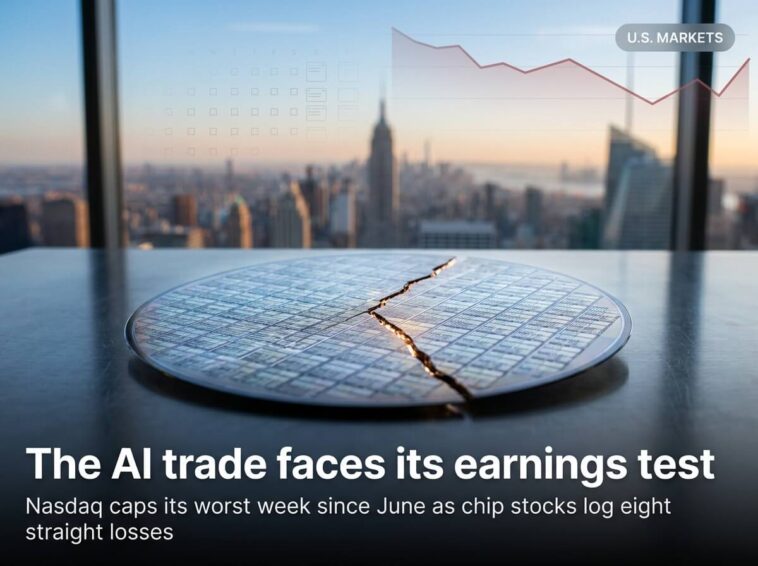
Nasdaq Sell-Off Caps Its Worst Week Since June, and the AI Trade Now Faces an Earnings Test
The Nasdaq sell-off ended last week with a thud, and Wall Street spent Monday morning trying to decide whether it’s over. Nobody knows. Not yet.
Friday did the damage. The Nasdaq Composite fell 2.1% to 26,140.03, and the S&P 500 lost 1.1% to 7,659.44. For the week, the Nasdaq dropped 4.5%, its worst stretch since June, while the S&P 500 slid 1.9%. The Dow, built from older industrial and financial names, still gained 0.7%. The VIX, Wall Street’s fear gauge, jumped more than 21% to 19.99.
The chip sector took the heaviest blows. The Philadelphia Semiconductor Index dropped 3.8% to 11,137.29, with all 30 of its stocks finishing lower. That marked its eighth straight losing session, the longest streak in nearly two decades. AMD fell about 6%. Intel dropped nearly 6%. Micron lost 5.6%. Arm shed almost 7%. CoreWeave sank 12%, and Dell fell 4.6% to cap a week in which it lost more than 22%.
Monday opened with a bounce. The Nasdaq gained about 1.1% at the opening bell, and the S&P 500 added roughly 0.6%. The Dow slipped 0.1% and the Russell 2000 dropped 1.7%. Cheaper oil gave traders room to exhale.
Today also happens to be the anniversary of Black Monday, when the Dow fell more than 20% in a single day in 1987. This isn’t that. A VIX near 20 signals nerves, not panic. Still, it’s been a rough stretch.
Why This Nasdaq Sell-Off Is Different
Look underneath the index, and the picture gets strange.
Through Thursday, 73% of S&P 500 stocks were higher for the week, even as the index itself fell. Most stocks were fine. A handful of giants weren’t. That’s the problem with a market this concentrated. According to Dow Jones Indices, roughly 45 companies with significant AI exposure generated about 39% of the S&P 500’s 14.1% gain through October 11. When that small group slips, the whole index feels it.
The deeper worry is money. AI companies are spending heavily on chips and data centers, and much of that spending runs on debt. CoreWeave’s slide Friday reflected exactly that fear: can heavily financed AI infrastructure earn profits fast enough to cover its obligations? Higher interest rates make the question harder to answer.
“Investors spent two years paying for AI growth without asking who funds it,” said Sandra Okoye, chief market strategist at a Manhattan investment firm. “Now debt costs more, and the answer matters. That doesn’t mean the technology fails. It means the price you pay for it can’t ignore the cost of borrowing.”
Bonds Sent a Mixed Message
Here’s the odd part. Inflation data last week ran hot. September CPI hit 3.7%, and wholesale prices jumped 6.3%. Normally that pushes Treasury yields up.
Instead, the 10-year yield fell about 14 basis points on the week to roughly 5.10%, and the 2-year slipped to around 4.73%. Why? Likely safety buying. When tech sinks, some investors rush into Treasuries, which pulls yields down even when inflation worries remain.
That relief may not last. Oil jumped about 10% last week before slipping Monday, and Treasury Secretary Scott Bessent blamed September’s inflation on an “energy shock.” If oil climbs again, so do inflation fears. And the Fed has entered its quiet period ahead of its October 28 decision, so officials can’t calm anyone’s nerves.
The Fed’s stance? Silent, yet looming.
The Counter-Narrative: A Rotation, Not a Rout
Not everyone sees disaster.
“Three out of four stocks rose last week,” said Greg Lindholm, a small-cap portfolio manager at a Denver asset manager. “That’s not a bear market. That’s money moving from the priciest names to everything else. The index looks ugly because it’s built top-heavy. Under the hood, the market is healthier than the Nasdaq suggests.”
He’s got a point. Capital isn’t fleeing stocks. It’s shifting. Yet small caps lost ground again Monday, so that rotation isn’t universal.
Earnings Week Delivers the Real Test
Netflix reports Tuesday after the close. On Wednesday come the big ones: Meta and Tesla after the bell, plus chip suppliers Lam Research and Texas Instruments. Meta’s spending guidance will show how durable AI investment really is. Lam and Texas Instruments should reveal whether the chip slump reflects fading orders or just fading sentiment.
Strong numbers could stop the bleeding. Weak guidance could extend it.
What Retail Investors Should Do Now
None of this is personal advice. Think of it as a checklist.
First, measure your concentration. Many investors hold an S&P 500 fund, a Nasdaq-100 fund and a tech ETF at once. Check each one’s top holdings. If the same handful of companies shows up three times, you’re making one big bet.
Second, consider an equal-weight fund. Unlike standard index funds, it gives every company the same share, so a few giants can’t dominate your returns. It won’t always win, but it spreads risk differently.
Third, resist the urge to catch a falling knife. Buying every dip in a stock that’s down eight days running isn’t a plan. If you’re adding money, spread it across weeks or months.
Fourth, keep some money in short-term Treasuries or cash for stability. Check current rates before choosing.
Fifth, mark the dates. Earnings Wednesday and the Fed on October 28 could move prices sharply. A calm plan made today beats a panicked decision made then.
The market doesn’t need to crash to hurt a portfolio that’s quietly all-in on one theme. This week will show whether the AI trade has the profits to match its prices.