Editor
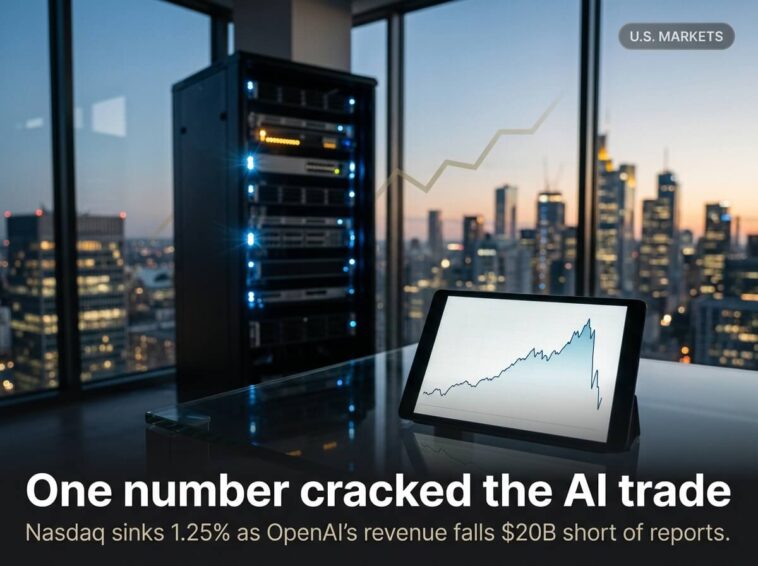
One Number Rattled the AI Trade: Nasdaq Sinks 1.25% as OpenAI’s Revenue Falls $20 Billion Short
AI stocks have been Wall Street’s favorite bet all year, and on Thursday one number cracked the confidence. Just one.
The Financial Times reported around midday that OpenAI told investors its annualized revenue was approaching $50 billion at the end of September. Media outlets had been circulating roughly $68 billion to $70 billion. That’s a $20 billion hole. Stocks tied to the AI buildout slid within minutes.
The Nasdaq Composite closed down 1.25% at 27,193.34, its worst day since mid-August. The S&P 500 fell 0.47% to 7,765.36, its second straight loss after Tuesday’s record. The Dow, shielded by non-tech names, actually gained 0.10% to 51,231.64. A split market. Tech took the beating alone.
Oracle dropped about 5.5%. Broadcom lost roughly 4.4%. Nvidia shed about 2.9%. The S&P 500’s technology sector slid nearly 2%.
Why AI Stocks Flinched at an Accounting Gap
Here’s the twist. Nobody says OpenAI’s business shrank.
The gap came down to how revenue is counted. According to a person familiar with the matter who spoke to CNBC, the higher figure included gross revenue from OpenAI’s partners, before sharing it with them. The newer, lower number is net. Reuters later confirmed the $50 billion figure. Apples to oranges, in other words, and the company’s growth is still fast.
So why the panic? Because the market had been paying for perfection.
When investors assign huge valuations to companies that supply chips, cloud capacity and financing to a single customer, any crack in that customer’s numbers matters. Oracle has multibillion-dollar contracts with OpenAI. Broadcom is reportedly arranging more than $50 billion in financing tied to a custom chip it’s building with the company. A smaller revenue base makes those commitments look heavier. Same debt. Thinner cushion.
“This wasn’t a collapse in demand. It was a reminder that the AI trade has been priced like nothing can go wrong,” said Daniel Okafor, chief investment strategist at a Manhattan advisory firm. “When the biggest customer in the ecosystem turns out to be smaller than the headline, every supplier’s growth math gets a second look.”
The Bond Market Sat in the Back Seat, Pushing
The sell-off didn’t happen in a vacuum. Treasury yields were already climbing.
On Wednesday, the Fed’s minutes showed most officials expect another rate hike by year-end. Long-term yields spiked to levels not seen in 24 years. On Thursday the 10-year briefly topped 5.35% before settling near 5.23%, and the Treasury’s 10-year auction cleared at 5.30%. The 30-year went at 5.62%. Add Brent crude above $100 after fresh tanker attacks in the Gulf, and inflation worries refuse to fade.
Why does that matter for tech? Because growth stocks are valued on profits far in the future. Raise the interest rate used to discount those profits, and the present value shrinks. A 5% risk-free Treasury is also now a serious rival to a richly priced stock. Investors can earn real income without betting on a chip cycle.
Stocks had been ignoring that math. Thursday, they didn’t.
The Counter-Narrative: A Buying Opportunity?
Not everyone sees trouble.
“Traders are treating a bookkeeping difference like a profit warning,” said Rebecca Lindqvist, a senior technology analyst at a San Francisco research firm. “OpenAI still told investors it’s growing at a blistering pace. The spending on chips and data centers isn’t going away because one revenue metric got restated. I’d use days like this to add.”
Her case has some support. Third-quarter profit forecasts remain strong, and the Dow’s resilience shows money didn’t flee the market, only the most expensive corner of it. Futures edged slightly higher after the close.
Still, her argument depends on earnings arriving as promised. That’s the part nobody can guarantee. And the pain was real: this was the Nasdaq’s worst session in about two months.
What Retail Investors Should Do Now
Panic is a bad strategy. Complacency is a worse one.
Start with concentration. Nvidia, Apple and Microsoft together account for roughly a fifth of the S&P 500. If you own an S&P 500 index fund, a Nasdaq-100 ETF and a tech sector fund, you may hold the same handful of names three times. Open each fund’s top-holdings list. Count the overlap.
Next, look at your rate sensitivity. Companies with big borrowing needs and profits far in the future suffer first when yields rise. That includes parts of the AI chain. It doesn’t mean selling everything. It means knowing how much of your portfolio needs cheap money to work.
Finally, weigh the alternatives. Short-term Treasuries now pay yields near the Fed’s policy rate, with far less price swing than long bonds or growth stocks. For cash you might need within a few years, that’s worth a serious look. And if you’re adding to stocks, spreading purchases over several months beats trying to catch the exact bottom.
What Comes Next
The next tests are close. The Fed meets again later this month, and a hike isn’t expected, but its tone will move long-term yields. Big banks kick off earnings season soon after. Any fresh detail on OpenAI’s finances, or comparable disclosures from other AI firms, could shake the trade again.
The Fed’s message? Hawkish, yet hedged. The AI trade’s message? Still strong, but no longer untouchable. Thursday proved that confidence cuts both ways.