Editor
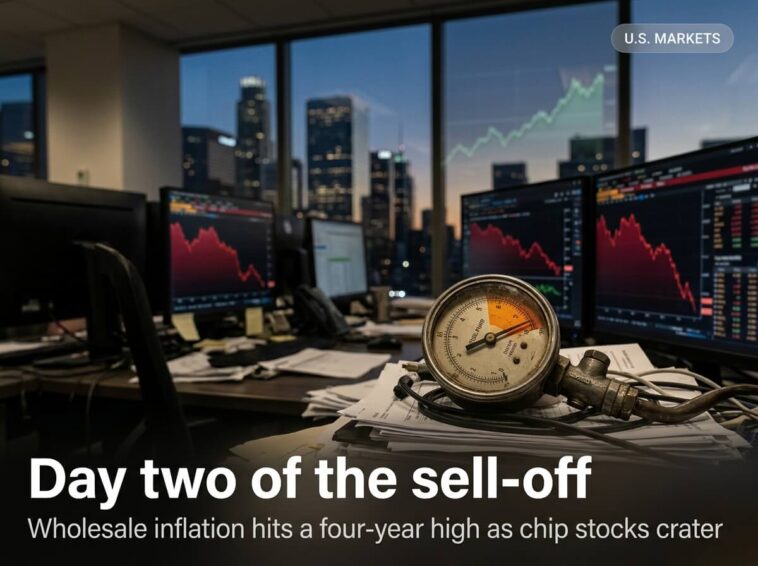
Stock Market Sell-Off Deepens as Wholesale Inflation Hits a Four-Year High and Chip Stocks Crater
The stock market sell-off hit its second day Thursday, and the inflation news didn’t help. It got worse.
Wall Street opened to a split screen. The S&P 500 slipped about 0.5% in early trading, the Nasdaq Composite dropped more than 1.3%, and the small-cap Russell 2000 lost nearly 2%. The Dow edged up about 0.4%. Rotation, not calm.
Wednesday set the tone. The S&P 500 fell 1.11% to 7,718.94, and the Nasdaq lost 1.88% to 26,692.87. Both marked their worst sessions since July, after September’s consumer price index came in hotter than expected.
Then came Thursday’s data. The producer price index, a gauge of what businesses pay before goods reach shoppers, jumped 1.3% in September. That’s the biggest monthly gain since early 2022. Annually, wholesale prices rose 6.3%, the fastest pace since December 2022 and well above the 5.5% economists expected.
Overseas, the damage was brutal. South Korea’s Kospi sank 7.6% to 5,554.22, and it has lost more than 16% in a month. Japan’s Nikkei tumbled 4.9%. SK Hynix fell more than 11%. Samsung dropped nearly 10%.
What’s Driving the Stock Market Sell-Off
Two forces collided this week, and they feed each other.
The first is inflation. Energy did most of the damage, with wholesale gasoline prices up about 20% in September, according to the Labor Department. But the pressure isn’t only at the pump. Diesel, jet fuel and electricity also climbed, and the producer price index for services rose 0.8% on the month. Oil near $100 keeps the pressure on.
The second is the AI buildout. Companies are spending enormous sums on chips and data centers, and a lot of that spending runs on borrowed money. When inflation stays hot, the Fed stays hawkish. Borrowing costs stay high. And that makes it harder to raise cash for the next data center. AP noted that costlier money complicates exactly that math.
Put simply: the AI trade assumes cheap financing and endless demand. Inflation threatens the first. Questions about returns, sparked by last week’s OpenAI revenue report, threaten the second.
“The market’s been paying tomorrow’s prices for AI profits,” said Jennifer Calloway, head of portfolio strategy at a Boston wealth manager. “When rates stay high, tomorrow gets a lot cheaper. That’s what you’re seeing in memory chips. Investors aren’t abandoning the story. They’re repricing it.”
Treasury yields eased a touch Thursday, but they remain elevated. The Fed raised rates in September and the minutes signaled more could follow. Two hot inflation reports in two days make another hike before year-end harder to dismiss.
Where Money Is Going Instead
Watch the rotation. While tech slid, health care shares gapped up to a record high at the open. The Dow’s gain came from blue-chip names outside the AI trade, and CoreWeave and chipmakers like AMD, Micron and Sandisk fell between 4% and 10%.
That’s classic defensive behavior. Investors aren’t leaving stocks entirely. They’re shifting toward companies that earn steady profits and don’t rely on cheap capital.
The Counter-Narrative: Is This a Buying Moment?
Not everyone is hitting the exits.
“Two bad days after a monster run doesn’t break a trend,” said Dev Malhotra, a technology equity strategist at a San Francisco research firm. “Third-quarter earnings are expected to jump more than 30%, and AI demand hasn’t vanished. Kospi’s been sliced by a sixth in a month, which smells like panic selling in a thin market. I’m watching for entry points, not running.”
His math isn’t crazy. Analysts do expect robust earnings growth. And forward valuations on the S&P 500 had fallen below 19 times earnings, the lowest since 2023, before this week’s decline.
But earnings only matter if the cost of money stops rising. And with wholesale inflation at 6.3%, that’s far from certain.
What Retail Investors Should Do Now
Panic is expensive. So is complacency. Here’s a framework, not personal advice.
First, check how much of your portfolio sits in tech and AI-linked names. Many investors hold these through several funds at once: an S&P 500 index fund, a Nasdaq-100 ETF, a tech sector fund. Open each one’s top holdings. If the same names appear everywhere, you own a bigger bet than you think.
Second, rebalance on a schedule, not on emotion. If tech has grown past the share you intended, trimming it back is routine maintenance. It isn’t market timing.
Third, give your cash a job. Short-term Treasuries now pay solid yields with far less price swing than stocks. Check current rates before you decide. For money you’ll need in the next few years, that’s a reasonable home.
Fourth, if you’re adding to stocks, spread purchases out. Buying in pieces over weeks avoids the trap of guessing the bottom.
Finally, avoid selling everything because of two bad sessions. History shows that sharp sell-offs often reverse, though sometimes slowly, and no one can promise which kind this is.
What to Watch Next
More earnings arrive this week, including from banks and tech names. Oil remains volatile, with tensions around the Strait of Hormuz keeping traders on edge. And every inflation reading now carries extra weight, because the next Fed decision hangs on it.
The Fed’s stance? Hawkish, yet cornered. The AI trade’s stance? Shaken. Thursday showed how quickly one turns into the other.