Editor
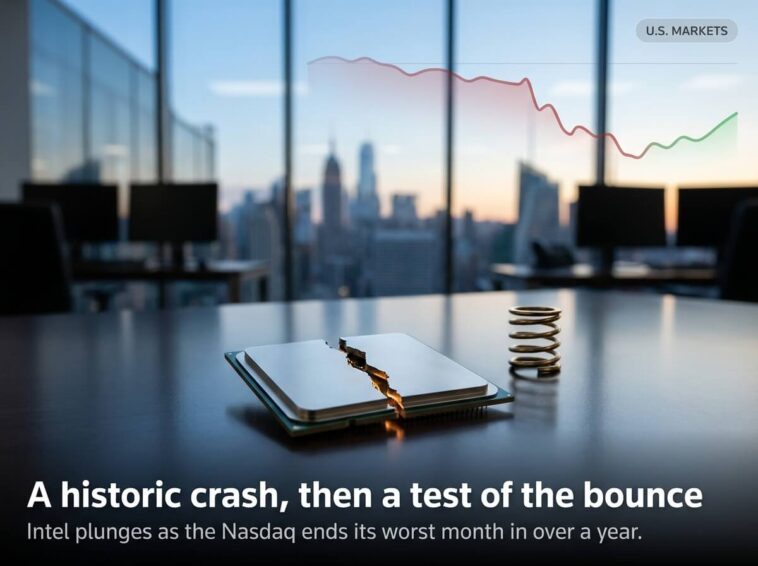
Intel Stock Suffers Its Worst Day Since 1974, the Nasdaq Closes Its Worst Month in Over a Year, and Wall Street Bets on a Bounce
Intel stock just had its worst day since 1974, and Wall Street is trying to move on. Monday is the first test.
Friday was ugly. The Nasdaq Composite fell 2.86% to 25,437.00, its worst day since June 5. The S&P 500 lost 1.82% to 7,580.07. The Dow dropped 572 points, or 1.09%, to 51,770.31. Intel plunged 28.58% after warning that fourth-quarter revenue would land between $15 billion and $16 billion, well below the roughly $17.1 billion analysts expected. Earnings guidance of 25 cents a share missed the 43 cents Wall Street wanted. Intel blamed weak PC demand, which it said higher memory chip prices are hurting.
The chip rout spread fast. Amazon added to the gloom, slipping 1.4% after missing on revenue and profit while holding a $220 billion capital spending plan for 2026. Reuters-based reports said Amazon’s cash burn hit a record, with trailing free cash flow reportedly negative by about $42 billion.
That capped a miserable October. The Nasdaq lost roughly 5.2% for the month, its worst since March 2025. The S&P 500 and Nasdaq each fell for a third straight week, the longest losing streak since March. The Dow actually gained nearly 2% in October as investors rotated into defensive sectors like health care.
Then came Monday’s turn. Oil tumbled more than 6% on reports of Iran peace talks, and stocks bounced at the open. By late morning, the Dow was up about 1.1% near 52,370, the S&P 500 had added roughly 1%, and the Nasdaq was up about 1.3%. Marvell agreed to buy Lumentum, adding a deal headline to the mix.
What Pushed Intel Stock Off a Cliff
Intel’s collapse wasn’t just about one weak quarter. Context made it worse.
Investors have spent weeks punishing the biggest AI spenders. Alphabet fell about 10% last week after a cash-flow miss. Meta stumbled the week before. Now Amazon and Intel showed the same pattern: heavy spending, thin returns. As one report put it, Friday’s sell-off was different because of the extra focus on credit. Amazon plans to raise capital spending significantly next year from $220 billion. Cash flow isn’t keeping up.
Intel’s drop also showed how stretched stocks had become. Even after losing nearly a third of its value Friday, Intel is still up about 78% this year. A stock that has nearly doubled can lose a lot and still look expensive.
“Investors stopped asking how big AI could get and started asking who pays for it,” said Elliot Marsh, chief strategist at a New York wealth boutique. “Intel gave them a clean example of what happens when guidance misses after a monster run. The hit isn’t proportional. It’s a cliff.”
Why Bond Yields Fell While Stocks Crashed
Look at Treasuries. They tell a second story.
On Friday, the 10-year yield fell about 4 to 7 basis points to roughly 4.92% to 4.94%, and the 2-year dropped about 5 basis points to 4.56%. The 30-year held near 5.31%. Yields fell even though the Fed had held a hawkish line only days earlier, with two officials voting for a hike. As of Wednesday, traders priced about an 85% chance of a December increase.
When yields fall in a sell-off, investors are running toward safety. They aren’t worried about inflation that day. They’re worried about growth and credit. That tells you the market’s fear has shifted, at least for now, from “the Fed will hike” to “the AI boom might disappoint.”
It also steepened the curve. The gap between the 2-year and 10-year yields widened to roughly 38 basis points. A steeper curve can signal that investors expect slower growth ahead, even as the Fed leans hawkish. It’s a mixed message, and the Fed will have to read it.
The Counter-Narrative: Don’t Trust the Bounce
Not everyone is celebrating.
“A one-day bounce after a three-week slide isn’t a bottom,” said Hugh Calder, a technical strategist at a Chicago research firm. “Credit worries are building around the big AI spenders, and the earnings that matter most are still ahead. Oil is down on headlines that could reverse in an hour. I’d treat this as a relief rally until proven otherwise.”
His caution matches what some market watchers noted Monday: investors remain willing to buy weakness, but confidence in tech is fragile. And oil, which rose about 15% in October on Iran tensions, can swing either way.
What Retail Investors Should Do Now
None of this is personal advice. It’s a checklist.
First, look at your concentration. If a few mega-cap tech names drive most of your portfolio, last week hurt more than the headline index suggests. Check how much of each fund sits in the same handful of companies.
Second, don’t chase the bounce. Buying a sharp rally in a downtrend is as risky as selling the bottom. Spread purchases over weeks, not hours.
Third, rebalance on a schedule. After a month like October, your stock and bond mix may have drifted. Trimming and adding back toward your targets is routine upkeep.
Fourth, consider short-term Treasuries. With the 2-year near 4.6%, cash and bills offer a real return while you wait. Check current rates before buying.
Fifth, mark the calendar. Apple reports after the closing bell Monday. The midterm elections are Tuesday. AMD and Palantir report this week, and Friday brings the jobs report. Any of them can move prices fast, so a plan made now beats a decision made in the moment.
What Comes Next
Earnings season isn’t over, and each AI report will be graded on cash flow, not just growth. The Fed meets again in December, and the jobs report on Friday could shift the odds. Oil and Iran headlines can break at any hour.
The Fed’s stance? Hawkish, yet watching. The AI trade’s stance? Bruised, but still bought on dips. October proved that spending big only works when the cash follows.