Editor
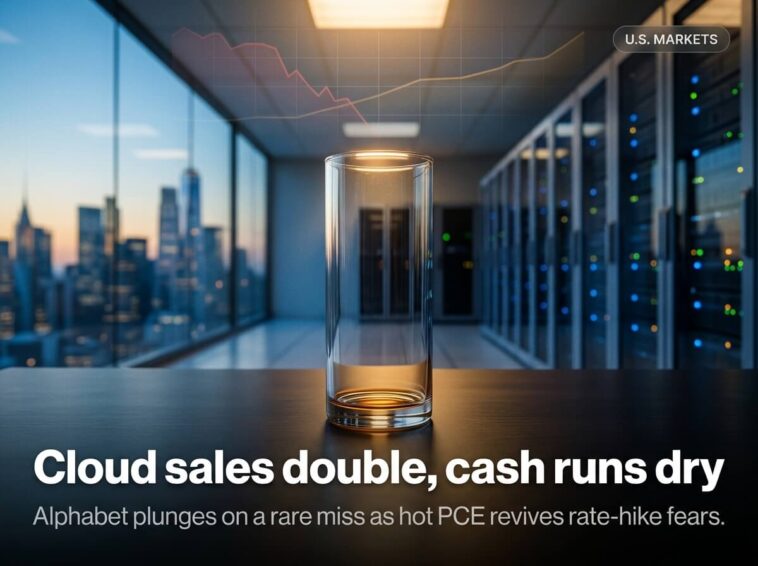
Alphabet Stock Plunges on a Rare Earnings Miss as Hot Inflation Data Piles On
Alphabet stock fell off a cliff Thursday, and it took the Nasdaq down with it. Bad night for tech. Worse morning.
The Google parent dropped about 10% after hours Wednesday and slid roughly 13% at the open, putting it on track for its biggest post-earnings drop ever. The prior record was a 9.77% fall. By Reuters’ math, the after-hours slide alone erased nearly $400 billion in market value.
The numbers explain the panic. Alphabet reported third-quarter revenue of $127.58 billion, just under the $128.2 billion analysts expected. Earnings came in at $2.12 a share against a forecast of $3.02, with part of the gap coming from an $8.2 billion unrealized loss on its SpaceX stake. Free cash flow turned negative by more than $9 billion. And it held its 2026 capital spending plan at $195 billion to $205 billion.
Google Cloud was the bright spot, with revenue up 103% to $30.71 billion. It wasn’t enough. An analyst at Quilter Cheviot called the results messy and the earnings call poorly handled.
Microsoft told a calmer story. It beat on cash flow and rose about 3% after hours, though it traded roughly flat Thursday morning. Software names got hammered anyway, with ServiceNow down 18% and Fortinet 26% after hours.
The Nasdaq opened more than 1% lower and, at one point, the Nasdaq 100 was off 1.8%. Marvell fell over 11% in premarket trading. It’s the same AI-spending worry that rattled markets last week, now with a bigger name attached.
Why Alphabet Stock Is Getting Hit So Hard
Cash. That’s the whole story.
Investors will tolerate huge AI budgets if profits follow. Alphabet is spending about $200 billion a year, and the quarter’s cash flow went the wrong way. When free cash flow turns negative at a company this size, the question changes from “how big can this get?” to “who’s paying for it?”
Rates make it worse. The Fed held steady Wednesday at 3.75% to 4%, but the 10-2 vote carried a message. Governor Lisa Cook and Cleveland Fed President Beth Hammack dissented in favor of a hike. The statement upgraded growth to “strong” and said inflation “remains elevated.” Chair Kevin Warsh declined to prejudge December and also announced the Fed will hold fewer meetings: seven next year and six the year after.
Stocks actually closed higher Wednesday. The S&P 500 gained 0.28% to 7,743.98, the Dow rose 0.19% to 52,475.10 and the Nasdaq added 0.27% to 26,549.85. It was the first time the S&P 500 finished higher on a Fed decision day since December 2025.
Thursday’s data spoiled the mood. The September PCE price index, the Fed’s preferred inflation gauge, rose 0.5% on the month and 3.6% from a year earlier, up from 3.4% in August. Core PCE ran 3.1%. Both matched forecasts. Energy prices jumped 9.2% in September. Meanwhile, third-quarter GDP grew 3.4%, beating the 3.1% to 3.2% economists expected.
Strong growth plus sticky inflation equals a Fed with every reason to hike. Markets now see an 85% chance of a quarter-point increase in December, up from 78% a day earlier.
“Alphabet showed that you can grow cloud sales 100% and still get punished if the cash doesn’t follow,” said Rebecca Sloane, head of technology equity strategy at a Manhattan investment firm. “With the 10-year at 5%, investors have a risk-free alternative. They no longer give AI spenders the benefit of the doubt.”
What the Bond Market Is Saying
Treasury yields tell the same tale. The 10-year closed Wednesday at 5.05% and eased to around 5.00% early Thursday. The 2-year fell about 5 basis points to roughly 4.69%, and the 30-year sat near 5.37%. The curve steepened after Warsh’s comments, since he sounded less eager to hike than the dissenters.
One market newsletter calculated that the S&P 500’s earnings yield is only about a quarter point above the 10-year Treasury yield. Treat that as a rough estimate. The point stands: when bonds pay 5%, stocks have little cushion for disappointment.
The Counter-Narrative: A Panic Worth Buying?
Not everyone is selling.
“The headline miss is partly an accounting mark on a SpaceX stake, not a collapse in the business,” said Tomas Eriksen, a senior equity analyst at a San Francisco research firm. “Cloud revenue doubled. Search is slowing but still enormous. Dropping 10% in a day on that mix looks like an overreaction. I’d rather own it here than chase it.”
He has a point about the accounting. Yet cash burn isn’t an accounting trick, and the search slowdown worries many investors. A smart buyer needs more than a lower price.
What Retail Investors Should Do Now
None of this is personal advice. It’s a checklist.
First, count your Alphabet exposure. It likely sits in your S&P 500 fund, your Nasdaq-100 fund and any tech ETF. A big single-day drop in one giant can sting even if you never bought the stock directly.
Second, don’t average down on reflex. Buying more of a falling stock because it’s cheaper only works if the reason for the fall is temporary. Figure out which it is first.
Third, remember the Fed calendar. December is the next big test, and November brings the midterm elections on the 3rd. Volatility can pop around either.
Fourth, check short-term Treasuries. With the 2-year near 4.7%, cash isn’t a bad place to wait. Check current rates before buying.
Fifth, spread purchases over time. If you want more tech exposure, adding gradually beats guessing the bottom.
What Comes Next
Amazon and Intel report after the closing bell Thursday, and each will answer the same AI-spending question Alphabet raised. Then come the midterms and the December Fed meeting.
The Fed’s stance? Hawkish hold, with two hawks wanting more. The AI trade’s stance? Rattled, again. Thursday’s message was simple: spend big, show the cash.