Editor
Consumer Confidence Surges as Gas Prices Ease, and Wall Street Walks Into the Fed Decision With Yields Back Above 5%
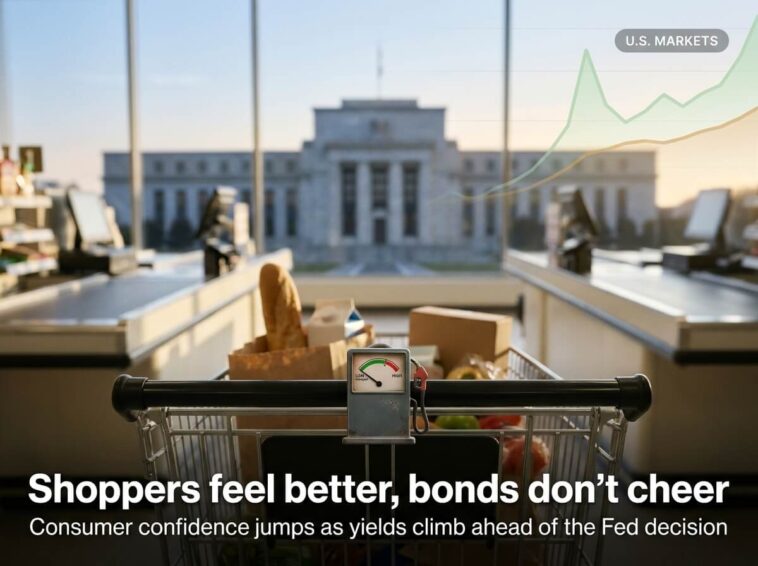
Consumer confidence jumped far more than anyone expected Tuesday, and the bond market didn’t cheer. Good news, bad timing.
The Conference Board’s index climbed to 91.7 in October from a revised 84.2 in September. Economists had forecast roughly 81. The 7.5-point jump is the highest reading since June, and the board’s economist credited cheaper gasoline and a slightly brighter job outlook. Durable goods orders added to the mood, rising 1.8% in September.
Stocks loved it. The Nasdaq Composite climbed 1.18% to 26,477.81, its second straight rally, with technology shares up about 2%. The S&P 500 gained 0.60% to 7,722.60, now roughly 1.2% below its record. The Dow barely moved, up 0.03% to 52,377.57, as a slump in Boeing offset the gains. Small caps joined the party, with the Russell 2000 up 1.16%. Energy was the day’s laggard, falling more than 2% as oil slid below $114 a barrel on hopes for Middle East diplomacy.
Then came Wednesday morning. Treasury yields ticked higher. The 10-year rose to about 5.02%, the 2-year to roughly 4.77%, and the 30-year to around 5.32%. Stocks mostly hovered, with the S&P 500 up 0.2% and the Nasdaq down 0.1%.
Why Strong Consumer Confidence Isn’t Simple News for the Fed
Here’s the catch. A sturdy consumer is great for companies. It’s less great for a central bank trying to cool inflation.
The Fed announces its decision at 2 p.m. Eastern, and Chair Kevin Warsh holds his press conference at 2:30. Futures put the odds of a hold near 90%, which would leave rates at 3.75% to 4%. The market’s real bet is on December, where a hike is priced at roughly 80%. No new dot plot or economic projections will accompany Wednesday’s decision. That leaves the statement and Warsh’s remarks to carry the message.
Consumer strength gives the Fed cover to keep tightening. Spending drives about two-thirds of the U.S. economy. If households feel better, they spend more, and demand-driven price pressure follows. September’s consumer prices rose 3.7% from a year earlier, and wholesale prices rose 6.3%, so nobody at the Fed is relaxed.
The yield curve shows how traders read it. The 2-year yield, which tracks Fed expectations, sits at about 4.77%, well above the top of the policy range. That gap says traders already expect more hikes. The 10-year, near 5%, reflects fears about inflation, oil and government borrowing on top of that.
“Confidence rebounded because gas got cheaper, not because anyone got richer,” said Priyanka Desai, a senior economist at a Washington research firm. “But the Fed doesn’t need a rich consumer to worry. It needs a spending consumer. A strong print gives hawks one more argument for December.”
The Warsh Pattern, and the Counter-Narrative
Traders have noticed a habit. Since Warsh took over as chair in May, stocks have generally fallen on Fed days and then recovered the next session, according to DataTrek Research’s Nicholas Colas. The S&P 500 rallied at least 1% on each of the three days following Warsh’s earlier meetings. The VIX has also risen on each decision day this year.
Does that guarantee anything? No. Patterns break.
Not everyone buys the hawkish story either.
“This is a gasoline bounce wrapped in a headline,” said Colin Mercer, a veteran bond strategist at a Chicago asset manager. “Confidence is still well below where it was a few years ago, and the board itself says the long-term trend is down. If oil keeps sliding, inflation cools on its own, and a December hike becomes unnecessary. The market is pricing in too much hawkishness.”
His argument has legs. Oil has eased from last week’s peak near $114.50, and cheaper gasoline is what lifted confidence in the first place. If energy keeps falling, the Fed may not need to act.
But oil has reversed before. The Iran conflict, tanker attacks and talk of renewed strikes after the November 3 midterms keep risks alive.
What Retail Investors Should Do Now
None of this is personal advice. It’s a checklist.
First, don’t trade the 2:30 press conference. Warsh has refused to preview what he’ll do, and prices can swing several times in minutes. A plan made this morning beats a panic made this afternoon.
Second, remember that good news can be bad news. Strong data can lift stocks and bonds in opposite directions when investors fear the Fed will respond. That’s why yields rose even as stocks rallied.
Third, check short-term Treasuries. As of Tuesday, three-month bills paid about 4.14%, six-month bills about 4.36% and one-year notes about 4.46%. These carry little price risk and roll into higher rates if the Fed hikes. Check current rates before buying.
Fourth, look at breadth. The equal-weight S&P 500 fund rose only 0.11% Tuesday while the standard index climbed 0.60%, a sign that a handful of big names did the heavy lifting. If your portfolio mirrors the index, so does your concentration.
Fifth, watch consumer-sensitive stocks with care. Cheaper gas helps retailers and restaurants, but higher borrowing costs hurt shoppers who carry credit card balances.
What Comes Next
The decision lands in hours. The midterm elections follow in less than a week. Microsoft, Alphabet and Amazon report earnings this week, and inflation data arrives Thursday.
The Fed’s stance? Hold now, hike later, say little. The market’s stance? Already bracing for December. What Warsh says at 2:30 will decide whether that bet gets bigger or smaller.