Editor
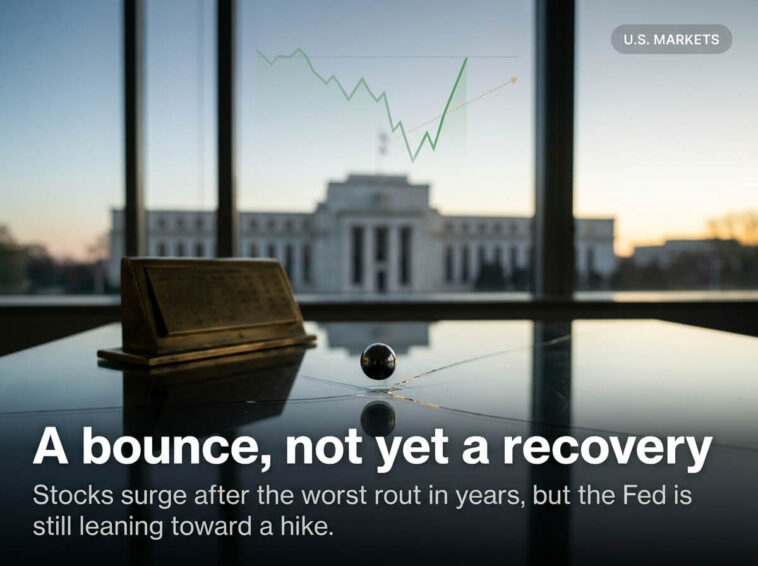
Wall Street Snaps Back From Its Worst Day in Years. The Fed Hasn’t Changed Its Mind.
The stock market rebound Wall Street had been praying for showed up Monday, and it showed up loud. By early afternoon, the S&P 500 was up about 2.3%, near 7,545. The Dow gained roughly 2.2% to top 52,400. The Nasdaq Composite climbed about 2.5% to around 25,200. (All figures are intraday, as of this writing.)
Needed? Absolutely. All three indexes ended last week in the red.
Thursday was the problem. The Nasdaq 100 lost 6.4%, its worst day since March 2020, and the S&P 500 dropped 4.4%, its worst since the April 2025 tariff shock. Nvidia shed 9%. Micron lost 17%. The VIX, Wall Street’s fear gauge, jumped nearly 70% in one session, a move that has happened only eight times since 1991.
Monday’s bounce is the first real exhale. But an exhale isn’t a recovery.
What’s Behind the Stock Market Rebound
Oil did the heavy lifting. Brent crude fell about 5% at the open on hopes for a diplomatic end to the war with Iran, with Qatar stepping up its mediation. Cheaper crude eases inflation fears, and inflation fears are what’s been holding this market back. AMD jumped more than 11% at the open. The Dow, heavy on industrials and lighter on chips, led the charge.
Not everyone joined in. Nvidia slid roughly 5.6% after the Wall Street Journal reported that its board opened a probe into CEO Jensen Huang. A company spokesperson told the paper Huang intends to remain in the job. Investors are also still sizing up whether tougher rules on how data centers get built, powered and financed could slow the AI buildout, a live worry since Democrats swept Congress last week.
“This is a relief bounce, and relief bounces are real,” said Claudia Reyes, Chief Investment Strategist at Hartwell Capital Partners in New York. “Forced sellers have mostly finished, oil is cooperating, and dip buyers are back. But a bounce tells you where the fear went. It doesn’t tell you where earnings are going.”
Fair distinction. Hold onto it.
The Fed Hasn’t Blinked
Here’s the part Monday’s green screens skip. The Federal Reserve, led by Chair Kevin Warsh, held its benchmark rate at 3.75%–4% on October 28. It was no victory for the doves. Traders walked away more convinced the next move is up.
Friday’s October jobs report beat forecasts, and bonds sold off hard. The 2-year Treasury yield climbed to about 4.52% and the 10-year to roughly 4.86%. Futures now put the odds of a quarter-point hike at the December 9 meeting near 77%. That would lift the range to 4%–4.25%.
A hike. Into a market that lost 4.4% in a single afternoon.
Oil is the one pressure valve. If peace talks hold and crude keeps sliding, inflation expectations soften and the Fed gets a little breathing room. If talks collapse, that math flips overnight. Bank of America’s Michael Hartnett has reportedly said he wants to see oil below $80 before he’s a buyer of stocks again. Brent settled at $94.62 last Wednesday and still has plenty of ground to cover.
The Counter-Narrative: Don’t Buy This Bounce Yet
Not everyone is cheering. Marcus Thorne, Head of Macro Strategy at Delvecchio Advisors in Chicago, thinks the crowd is reading too much into one green day.
“Everyone wants to call this a V-shaped recovery,” Thorne said. “History says buyers usually win the following month after a volatility spike like Thursday’s. It also says the S&P typically gives back nearly 6% from its high at some point inside that month. Don’t confuse the first fact for a guarantee against the second.”
He has a point. A market that just lost its footing doesn’t get it back because oil dipped for a day. And the Fed’s December meeting hasn’t moved an inch closer to dovish.
What the Yield Curve Means for Your Money
Look at the spread. The 2-year sits near 4.52%, the 10-year near 4.86%. The curve slopes upward, but the short end is the part repricing for a hike. Translation: bond traders expect tightening, not relief. They aren’t buying the “everything’s fixed” story the equity tape is telling.
So what does a retail investor do with that?
First, stop treating cash as a penalty box. Short-term Treasuries and T-bills are paying roughly 4.5% with almost no price risk. Money you’ll need within two years belongs there, not in a rebound trade.
Second, don’t deploy fresh cash in one lump. Stagger purchases across several weeks. If December brings a hike, you’ll be glad you kept some powder dry. If it doesn’t, you still got in at a decent average price.
Third, check your AI exposure. Thursday showed what happens when a handful of stocks carry an entire portfolio. If chip and data center names now make up a big slice of your 401(k) or brokerage account, the rebound is a chance to trim, not to pile on.
Monday’s rally is real. Treat it as a reprieve, not a green light. The Fed meets December 9, and it hasn’t said a word about easing.