Editor
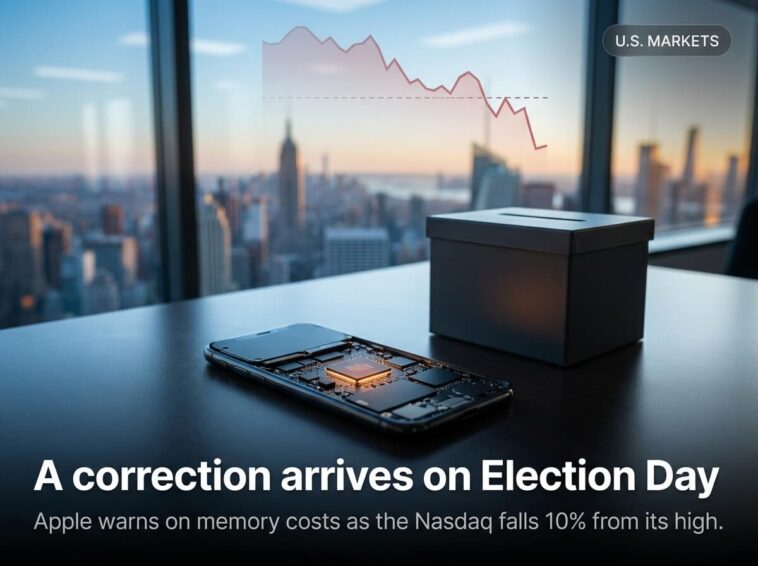
Nasdaq Correction Is Official as Apple Warns on Memory Costs and Wall Street Waits on the Midterms
The Nasdaq correction is now official, and Apple just made it harder to shake. Election Day arrived with a sour mood.
The Nasdaq-100 closed Monday more than 10% below its all-time high, which is the textbook definition of a correction. It sits about 10.4% under its October record. The cause is familiar: worry that Big Tech’s enormous AI spending isn’t earning enough to justify itself.
Monday’s session told the story. Tech rallied at the open as oil tumbled on Iran peace-talk reports. Then the rally died. By the close, the Nasdaq Composite had fallen 1.07% to 25,164.36, and the S&P 500 dropped 0.5% to 7,541.40. Only the Dow gained, rising 0.4% to 51,983.98 as cheaper oil helped non-tech names.
Tuesday opened mixed. The S&P 500 rose about 0.2%, the Nasdaq gained between 0.5% and 0.8%, and the Dow slipped about half a percent. Chip stocks led the bounce, with Nvidia up around 2.8% after four straight losing sessions. Apple led the other direction.
What Apple’s Warning Says About the Nasdaq Correction
Apple’s report looked great. The market didn’t care.
The iPhone maker posted fiscal fourth-quarter revenue of $114.48 billion against forecasts of about $113.39 billion. Earnings came in at $2.10 a share versus the $1.99 analysts expected. Then it warned that rising memory-chip costs will squeeze its profit margin during the holiday quarter. iPad sales also disappointed, and Greater China revenue fell short.
Shares dropped about 4% to 4.5% in premarket trading. That’s roughly $202 billion of market value gone before most investors finished breakfast. It also stung because Apple had just overtaken Nvidia as the world’s most valuable company last week, after Nvidia’s slide. Palantir fell despite beating estimates, and Shopify joined the decliners.
Here’s the pattern worth noticing. Memory costs are now a problem for everyone but the chipmakers. Intel blamed higher memory prices for weak PC demand when its stock collapsed Friday. Apple cited the same pressure Monday. The AI boom is soaking up memory chips, which raises prices for companies that build phones and laptops. That feeds into consumer electronics prices, and it complicates the inflation fight at a Fed already leaning toward another hike.
“The AI buildout has a cost that doesn’t show up in anyone’s capital budget,” said Carolyn Reyes, chief market strategist at a Boston wealth firm. “It shows up in the margins of every company that buys memory. Apple’s warning is the clearest proof yet that the boom is taxing the rest of the tech sector.”
Where the Bond Market Fits In
Treasury yields offer a useful backdrop. The 10-year yield fell back below 5% last week, closing Friday near 4.92% to 4.94%, and the 2-year sat near 4.56%. That’s a gap of roughly 38 basis points, a steeper curve than earlier in the fall.
A steeper curve usually means investors expect slower growth ahead while the Fed keeps rates high. The Fed holds its next meeting in December with a hike still on the table, and its last decision came with two dissents in favor of raising rates now.
That’s an uncomfortable squeeze. High rates press valuations. Rising input costs press margins. Together they explain why strong earnings aren’t lifting stocks.
The Counter-Narrative: Corrections Are Normal
Not everyone is alarmed.
“A 10% pullback in a bull market isn’t a crisis, it’s housekeeping,” said Leonard Voss, a senior portfolio manager at a Dallas fund. “Nvidia rebounded this morning. Chip demand hasn’t disappeared. The money rotating out of tech is moving into health care and other defensive areas, which tells me investors are rebalancing, not fleeing. I’d be adding selectively here.”
He has a point. The Dow gained nearly 2% in October while the Nasdaq lost more than 5%. Money is moving around, not leaving.
But a correction can slide into something worse. The Nasdaq has fallen for three straight weeks, and the next AI earnings reports will matter.
What Retail Investors Should Do Now
None of this is personal advice. It’s a checklist.
First, don’t trade the election. Markets often swing on results, then settle. Sorting out which party wins and what it means for stocks takes time, and the first reaction is often wrong.
Second, check your concentration. If a few mega-cap tech names drive your portfolio, this correction hit you harder than the S&P 500’s decline suggests. See how much of each fund holds the same companies.
Third, know the difference between a correction and a crash. A 10% drop is common during a bull market, and it doesn’t call for panic selling. A plan you set when markets were calm should guide you now.
Fourth, rebalance if your mix has drifted. After October, your stock share may be lower than you intended. Adding back gradually beats trying to guess the bottom.
Fifth, look at short-term Treasuries for money you might need soon. With the 2-year near 4.6%, bills pay a solid return with far less swing than stocks. Check current rates before buying.
Sixth, mark the calendar. AMD reports Tuesday, the jobs report arrives Friday, and December’s Fed meeting looms.
What Comes Next
Polls close tonight, and results will compete with AMD’s earnings for attention. Friday’s jobs data could shift the odds of a December hike. Oil, swinging on Iran headlines, remains the wild card.
The Fed’s stance? Hawkish, yet uncertain. The AI trade’s stance? In correction, and still asking for proof. Today’s votes won’t answer that question. Earnings will.