Editor
CoreWeave Revives the AI Trade. The Fed Still Holds the Bill.
NEW YORK — November 11, 2026
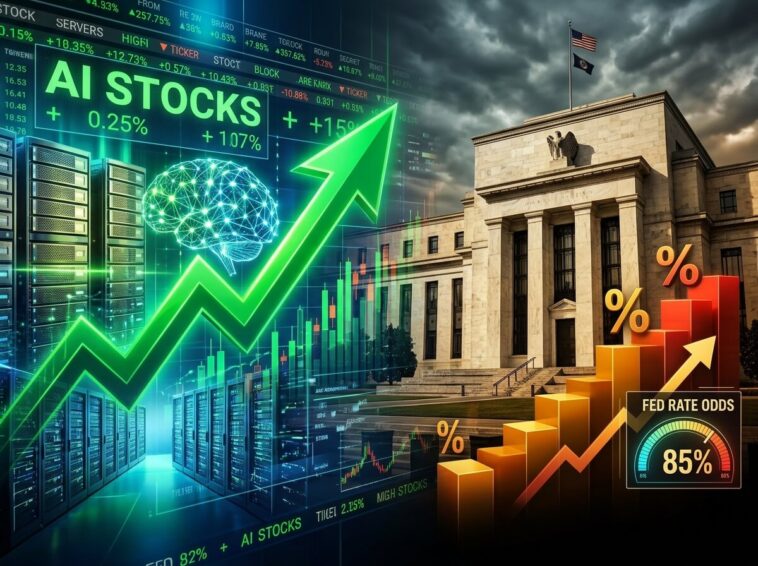
AI stocks staged another sharp reversal Wednesday, and a single earnings report did most of the work. CoreWeave jumped more than 26% the day after its results, pulling chipmakers and the Nasdaq out of a slump. By 1:43 p.m. ET, the Nasdaq Composite was up about 2.3% near 25,640. The S&P 500 had gained roughly 1.7% to 7,646. The Dow? Up about half a percent. (All figures are intraday, as of this writing.)
Whiplash. That’s the word for this week.
Tuesday was ugly. October consumer prices rose 0.4%, above the 0.3% economists expected, and core inflation, which strips out food and energy, rose 0.3% for the third straight month. Stocks closed lower. One session later, the mood flipped again. Up, down, up, down. Nobody on the floor is calling it a trend.
Why AI Stocks Ripped Higher on One Earnings Report
CoreWeave, which rents out AI computing power, soared to about $61.66 a share. Benzinga tallied more than $500 billion in value added across tech. Micron rallied roughly 13%. Nvidia bounced about 3% in premarket trading after two straight losses tied to the board’s investigation of CEO Jensen Huang. Bank of America called CoreWeave’s funding challenges manageable and sees the stock more than doubling from here.
The timing matters. Last Thursday’s rout, which sent the Nasdaq 100 down 6.4%, was fueled by doubts over whether the AI spending boom could survive tighter data-center rules and shakier financing. CoreWeave’s numbers answered part of that. Customers are still paying.
“Last week the market asked one question: is anyone still writing checks for this buildout?” said Dana Whitfield, Senior Portfolio Strategist at Larkspur Asset Management in Boston. “CoreWeave said yes, loudly. That’s why money rushed back in a single session.”
Look closer, though. The Dow barely moved. If you didn’t own tech Wednesday, you watched this rally from the sidelines. Even the equal-weighted story is thin.
The Fed Math Didn’t Change
Tuesday’s inflation report was the last one the Fed will see before its December 8–9 meeting. The next CPI reading doesn’t arrive until December 10, one day after the decision. The Bureau of Labor Statistics also published no annual inflation rate for October, a gap left by last year’s government shutdown.
Fed Governor Christopher Waller set the test himself. In London, hours before the data, he said a half-point hike should be on the table if core CPI came in around 0.3%. It did. Waller still leans toward a quarter-point increase, but CME FedWatch now shows roughly an 85% chance of a quarter-point hike and about 15% for a half-point. A week ago, a half-point was near zero.
The benchmark rate sits at 3.75%–4%. A quarter-point move would push it to 4%–4.25%. Fed Governor Michelle Bowman added to the pressure this week, saying inflation is broadening and further hikes may be needed.
Here’s the wrinkle. The 10-year Treasury yield sat at 4.98% heading into Wednesday. Veterans Day closed the cash bond market, so no Treasury trading tested the stock rally. Bonds get their say Thursday.
Equities partied. Bonds were closed. That tells you what the bond desk hasn’t said yet.
The Counter-Narrative: One Report Isn’t a Thesis
Marcus Thorne, Head of Macro Strategy at Delvecchio Advisors in Chicago, isn’t joining the celebration.
“One company’s earnings don’t repeal three straight 0.3% core prints,” Thorne said. “Stocks are pricing a clean AI recovery. The Fed is pricing a stubborn inflation problem. Both can’t be right for long, and when they collide, the Fed has historically won.”
He also points to crowding. Bank of America has warned that the S&P 500 itself has become the most crowded equity ticker in the world. Crowded trades rally hard. They also unwind hard.
Thorne isn’t predicting a crash. He’s predicting that Wednesday’s gains are the easy part, and December’s meeting is the hard part.
What This Means for Your Money
Think about this in terms of the yield curve. A 10-year yield near 5%, with the Fed’s policy rate at 3.75%–4%, tells you bond investors want extra pay for inflation and government borrowing risk. And a December hike would lift short-term rates, too. Cash isn’t dead money anymore. It also isn’t a place to hide for years.
Three practical moves:
Attack variable-rate debt first. A hike lifts credit card and home equity line rates almost immediately. Paying those down is a guaranteed return no stock can promise. With the average 30-year mortgage at 7.3%, borrowing costs are already punishing.
Use the bounce to rebalance. If tech and AI names have crept above your target after a 2% day, trim them. Selling into strength beats selling into a panic.
Park near-term money in T-bills or short Treasuries. Anything you need within two years can earn solid yields without exposure to a chip-stock swing. Save the stock money for the long game.
CoreWeave gave Wall Street its best day in a week. The Fed meets in four weeks. Plan for both.