Editor
Fed Rate Hike Now Looks Locked In as Hot Inflation Pushes the 10-Year Yield Back to 5%
A Fed rate hike in December went from likely to certain on Tuesday, and the bond market took it hard. Stocks followed.
Start with the data. Consumer prices rose 0.4% in October, above the 0.3% economists expected, though cooler than September’s 0.6% jump. Core prices, which strip out food and energy, rose 0.3% against a 0.2% forecast. The report didn’t include annual figures, because last year’s government shutdown limited the data available.
Hours earlier, Fed Governor Christopher Waller had set a trap. Speaking in London, he said he’d back a quarter-point hike in December even if inflation cooled. But if core prices rose around 0.3% or more, he said, a half-point hike should be considered. Then the number came in at exactly 0.3%.
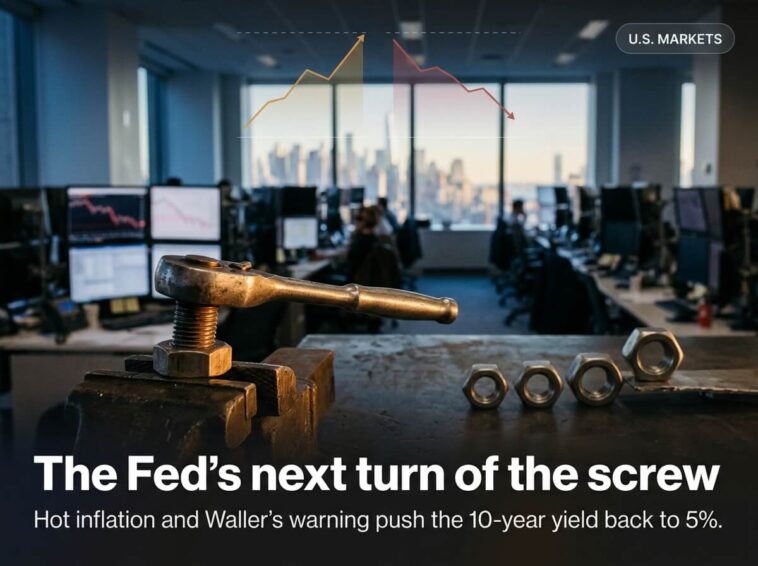
Markets did the math. The 10-year Treasury yield jumped about 14 to 15 basis points to roughly 5.00%, back above that line for the first time since earlier this month. The 2-year yield surged around 19 to 21 basis points to about 4.75%. Traders now price a December hike as a done deal, and the odds of a jumbo 50-basis-point move leapt from roughly zero to about 15%.
Stocks gave back part of Monday’s big bounce. By 1:29 p.m. Eastern, the S&P 500 was down about 0.9%, the Dow had lost 319 points, or 0.6%, and the Nasdaq Composite was off 1.4%. Bitcoin slid to nearly a three-month low.
Why a Fed Rate Hike Looks Locked In
Waller wasn’t alone. Dallas Fed President Lorie Logan said the Fed needs at least two more quarter-point hikes and suggested it may need to move faster this winter than it did this fall. Waller said hiking only a quarter point could put the Fed’s credibility at risk.
Credibility is the key word. Inflation has run above the Fed’s 2% target for more than five years. Core prices have now risen 0.3% in August, September and October. That’s three months of the same hot pace.
The Fed raised rates in September, taking its target to 3.75% to 4%. A December hike would push it to at least 4% to 4.25%.
Bond traders also had a technical problem. A $42 billion auction of 10-year notes came in soft. Dealers were left holding about 10% of the sale, the most since May, according to one strategist. When buyers hesitate, yields rise.
“The bond market just heard three things at once: hot core inflation, a Fed governor opening the door to 50, and a weak auction,” said Nathan Ellery, head of fixed-income strategy at a New York boutique firm. “Any one of those moves yields. All three together is a stampede.”
What the Yield Curve Is Saying
Watch the shape. It changed.
Last Friday, the 10-year yield sat near 4.88% and the 2-year near 4.52%, a gap of roughly 35 basis points. By Tuesday, the 10-year was about 5.00% and the 2-year about 4.75%. The gap shrank to around 25 basis points.
That’s a flattening, and it happened because short-term yields jumped more than long-term ones. Short rates follow the Fed. When traders expect bigger and faster hikes, the 2-year moves first. A flatter curve means investors see tighter policy ahead, and some worry it could slow growth later.
Context matters too. The 10-year topped 5.30% in early October and fell for weeks before Tuesday. In October, the 10-year and 30-year hit 24-year highs. Tuesday’s jump erased much of that relief.
Nvidia Adds to the Pressure
Rates weren’t the only drag on tech. Nvidia, the market’s heaviest stock, fell more than 4% on Monday and about 6% on Tuesday. The board has launched an investigation into reports about CEO Jensen Huang’s relationship with a woman U.S. intelligence reportedly links to the Chinese government. President Donald Trump said the FBI is looking into it, and a shareholder lawsuit followed. The allegations remain unproven.
The fallout came right after the Nasdaq entered correction last week and then rallied sharply Monday. On Monday, the Dow closed up 2.15% at 52,389.75, the S&P 500 up 2.35% at 7,549.94 and the Nasdaq up 2.74% at 25,253.14. Tuesday erased a chunk of that.
The Counter-Narrative: The Fed Can Wait
Not everyone wants a hike.
“Oil fell 5% on Monday, and energy is what pushed prices up,” said Rosa Delgado, an independent economist in Austin. “Core at 0.3% is not a crisis. A Fed that hikes into a stock-market correction and a cooling oil price risks overshooting. I’d hold in December and watch two more months of data.”
She has a point. Brent crude dropped sharply Monday on hopes the Iran conflict could end, and falling energy costs could cool inflation soon. A 50-basis-point jumbo hike would also be rare.
But the Fed has already signaled it prefers acting early. And Waller’s argument is simple: if three straight months of 0.3% don’t count as persistent, what does?
What Retail Investors Should Do Now
None of this is personal advice. It’s a checklist.
First, pay down variable-rate debt. Credit cards, home equity lines and adjustable loans track the Fed’s rate. A December hike, or two, makes them costlier. Paying them off can beat nearly any investment return.
Second, check bond fund duration. Long-term bond funds drop when yields rise. If your fund holds mostly 10-year and longer bonds, Tuesday hurt. Shorter-term funds swing less.
Third, consider short-term Treasuries. With the 2-year near 4.75%, short bills and notes pay a solid return with far less price risk. Check current rates before buying.
Fourth, don’t trade the headline. Prices swung wildly this week. Selling after a drop or chasing a bounce often backfires. A plan set in calm conditions beats a reaction in a panic.
Fifth, understand how higher rates hit stocks. Growth companies, whose profits come years from now, suffer most. Check how much of your portfolio sits in a handful of mega-cap tech names.
Sixth, keep a cash cushion. Volatility is high, and an emergency fund keeps you from selling stocks at a bad moment.
What Comes Next
More Fed speakers will weigh in this week. The next jobs and inflation reports come before December’s meeting, and each can move the odds of a 50-basis-point hike. Oil and Iran headlines remain a wildcard.
The Fed’s stance? Hawkish, and now eager to prove it. The market’s stance? Bracing. Tuesday didn’t just confirm a hike. It raised the question of how far the Fed will go.