Editor
AI Stocks Crash as Global Chip Selloff Goes Nuclear: Korea Plunges 9.99%, Google Bleeds Talent
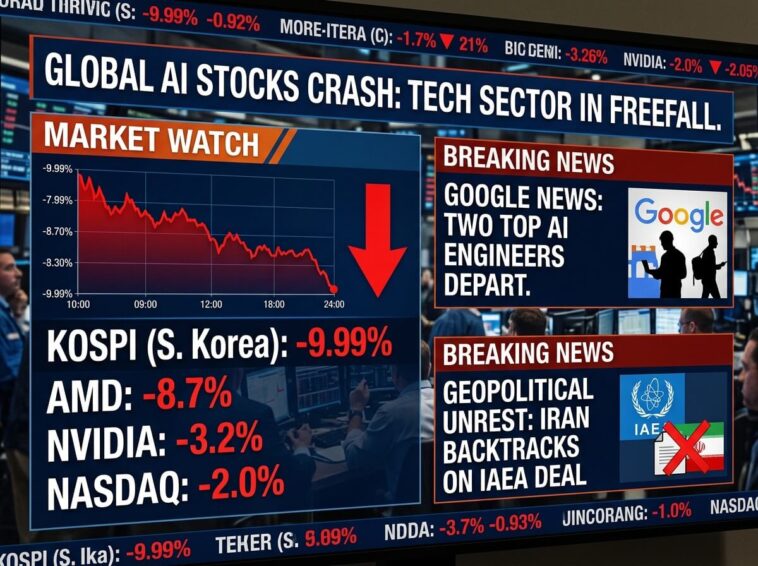
AI stocks are getting demolished in one of the most vicious global selloffs of 2026, with South Korea’s benchmark KOSPI plummeting 9.99%—its steepest single-day drop in more than three months—as Samsung Electronics and SK Hynix each tumbled more than 12%, triggering an automatic 20-minute trading halt. The carnage spread everywhere.
The S&P 500 fell 1.3%. The Nasdaq Composite slid 2%. The Dow Jones Industrial Average traded around the flatline. Nvidia tumbled 3.2% to $201.97. Intel, Marvell, and AMD lost between 6.2% and 8.7%. Japan’s Nikkei 225 dropped 3.6%. Europe’s tech stocks shed 2.7%. This wasn’t a dip. This was global capitulation.
And the catalyst? Wall Street’s AI-driven rally hit a speed bump as investors grew increasingly concerned about the enormous costs associated with developing AI technologies. Companies are committing unprecedented amounts of capital to build AI infrastructure—data centers, chips, computing networks—without clear visibility into the timing and magnitude of future returns.
Translation: The AI bill just arrived. And nobody wants to pay it.
“This is the ROI reckoning moment everyone who watched the dot-com bubble should’ve seen coming,” says Marcus Richardson, Chief Market Strategist at Granite Peak Capital in Boston. “Amazon, Microsoft, Meta, Alphabet—they’ve collectively committed over $500 billion in AI capex for 2026. That’s not investment. That’s an act of faith. And when faith meets quarterly earnings pressure, faith loses. Investors just decided they’re not financing blind bets anymore.”
The Google Talent Drain That Terrifies Every AI Bull
Here’s the story nobody’s connecting properly. Google’s Alphabet stock fell about 5% Monday—its worst decline since May 2025—and dropped another 2% Tuesday. Why? Not earnings. Not valuation. Talent.
Google’s vice president of engineering and co-lead of its Gemini AI models Noam Shazeer announced he was leaving for OpenAI. Then DeepMind vice president and engineering fellow John Jumper announced he was leaving for Anthropic.
Two top AI engineers. Two rival companies. In one week. That’s not coincidence. That’s defection. That’s the world’s most important engineers voting with their feet about where the AI future gets built. When the people BUILDING Gemini decide OpenAI and Anthropic are better destinations? That’s an existential signal about Google’s AI leadership position.
Shares of Alphabet were lower in premarket trading on Tuesday, following the stock having its worst day in more than a year on Monday. Alphabet is the third-largest company in the world. A 5% single-day decline erases roughly $100 billion in market cap. That’s not noise. That’s institutional money saying “we believe the talent drain changes Google’s competitive position permanently.”
South Korea’s 9.99% Crash Is The Warning Nobody Heeded
Let’s be honest about what happened in Seoul. South Korea’s KOSPI plummeted 9.99%—its steepest drop in more than three months. Overseas investors dumped chip stocks after regulatory signals suggested the sector’s rally had become overheated.
Market bellwethers Samsung Electronics and SK Hynix each tumbled more than 12%. An automatic 20-minute trading halt was triggered. That’s circuit-breaker territory. That’s a market that overheated so fast the exchange itself said “stop.”
This matters for U.S. investors because Korean chip companies are the canary in the semiconductor coal mine. SK Hynix supplies memory chips to Nvidia’s AI systems. Samsung competes directly with Micron. When Korean regulators signal “overheated” and institutional investors dump in panic? U.S. semiconductor stocks follow with a 24-hour lag.
That lag just expired. Intel down 6.2%. Marvell down 7.8%. AMD down 8.7%. The Korean crash arrived on American shores right on schedule.
Iran’s Reversal Piles On
As if AI concerns weren’t enough, Iran just threw a wrench into the peace narrative. Iran’s foreign ministry spokesman said Tuesday there were no “plans for IAEA inspections” of nuclear sites, directly contradicting Vice President JD Vance’s optimism. Iran’s chief negotiator told state media that the Strait of Hormuz will “never return to its pre-war conditions.”
Never. Not “modified.” Not “negotiated.” Never. That’s Iran walking back the core premise of the peace deal—normalized Hormuz transit—that markets have been celebrating for two weeks.
Oil prices were lower, suggesting markets partially discounted this reversal. But the geopolitical uncertainty just returned exactly when chip stocks needed stability most.
The Contrarian Case: Why One Strategist Says Buy This Dip
Not everyone’s running. Derek Hollis, Senior Technology Analyst at Summit Peak Advisors in New York, sees today’s global selloff as the capitulation moment that historically creates multi-year buying opportunities. “Every major technology cycle has a moment where the market decides the capital spending is too high and the returns are too uncertain,” Hollis argues. “The internet in 2000. Mobile in 2009. Cloud in 2016. Each time, the doubters were right for six months and wrong for six years.”
Hollis points to IBM popping 4% following an upgrade to overweight at JPMorgan, and Microsoft and Amazon moving higher even during the chip carnage. “The market isn’t abandoning AI. It’s rotating within AI from pure-play chip exposure to companies with actual revenue models. That’s not capitulation. That’s maturation.”
Maybe he’s right. Or maybe we’re watching the first act of a genuine AI bubble deflation that takes semiconductor stocks down 40% before it finds a floor.
What Retail Investors Must Do Right Now
First, understand that the global chip selloff triggered by Korea’s 9.99% crash is structural, not temporary. Regulatory signals about overheating and ROI skepticism don’t resolve in 48 hours. This takes weeks to digest.
Second, watch Micron’s earnings Wednesday after close. The week ahead features PCE inflation data and Micron results. If Micron guides lower? The semiconductor selloff accelerates. If it guides higher? You get a relief bounce. Position accordingly. Charles Schwab
Third, sell AI stocks that have no earnings story. Pure-play AI infrastructure plays—companies betting on data center demand without proven revenue—face the most brutal repricing when ROI skepticism peaks.
Fourth, rotate into defensive names that are ALREADY working. IBM up 4% on JPMorgan upgrade. Sherwin-Williams and Merck gaining. Walmart, Procter & Gamble, Johnson & Johnson all moving higher while chips crater. The rotation is happening in real time. Follow the money.
Fifth, watch Thursday’s PCE inflation data as the next major trigger. If inflation stays elevated AND chip stocks are crashing? The Fed hikes and growth stocks face dual headwinds that could push the Nasdaq another 5% lower before stabilization.
The AI bill arrived today. It was $500 billion in capex with uncertain returns. South Korea said “overheated” and dumped. Google lost its best engineers to rivals. Iran walked back IAEA inspections. Nvidia dropped below $202.
This isn’t a dip. This is the market finally doing the math on AI and not liking the answer.