Editor
Stock Market Today: The Jobs Number Nobody Wanted Just Landed
Stock market today looks calm on the surface. Underneath, something cracked. US stocks barely budged Thursday morning as investors absorbed a fresh batch of earnings, prospects of an imminent Strait of Hormuz deal, and new labor market data, with the Dow trading at a record high. The Dow slipped 0.2%, risking its record-breaking win streak, while the S&P 500 hovered just above flat and the Nasdaq edged up 0.2% as chip stocks clawed back early losses. Yahoo FinanceYahoo Finance
Barely budged. That’s the polite way to describe a market catching its breath.
Because Wednesday already delivered the warning shot. The Nasdaq Composite slipped 0.8%, snapping a four-day rally, and the S&P 500 retreated from its record to close down nearly 0.2%. The party’s not over. But somebody just turned the lights up. Yahoo Finance
The ADP Jobs Miss Behind Today’s Wobble
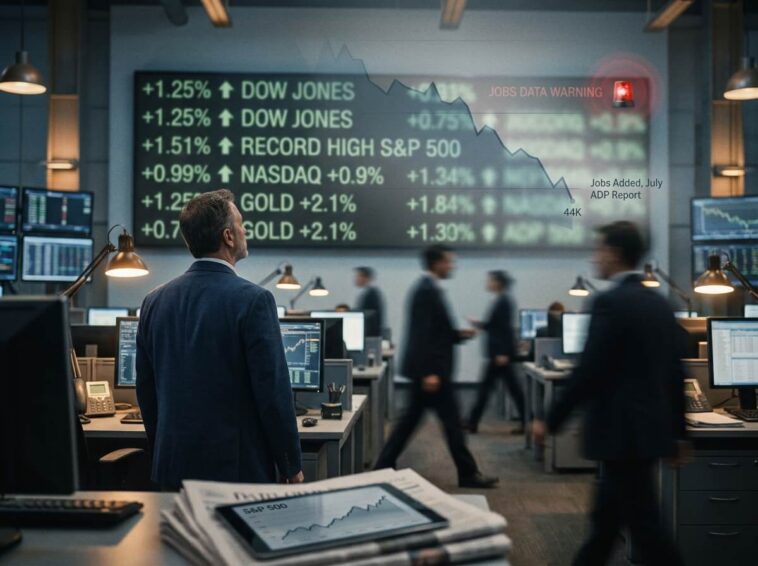
Here’s the number that matters. Private-sector hiring slowed considerably in July, with nonfarm job growth outside government totaling a seasonally adjusted 44,000 — well below the downwardly revised 95,000 gain in June and short of the Dow Jones consensus forecast of 75,000. CNBC
Not a miss. A whiff.
Nearly all of the gains came from services, which added 47,000 jobs, while goods-producing industries actually shed 3,000. Education and health services alone contributed 36,000 of the total. Strip that sector out, and the picture gets uglier fast. CNBC
July’s total marked the weakest monthly reading of the year, a sharp reversal from May’s broad-based 122,000 gain. Four straight months of cooling. That’s not noise. That’s a trend line. Quartz
ADP’s chief economist, Nela Richardson, noted that “job-changers are highly sensitive to real-time economic conditions” — and their pay growth accelerated even as hiring slowed, suggesting supply constraints in specific corners of the labor market rather than a broad collapse. Fox Business
Translation: it’s not 2008. But it’s not nothing, either.
“This is the kind of print that forces a re-think,” said Marcus Thorne, Head of Macro Strategy at Delvecchio Advisors in Chicago. “You can’t have four consecutive months of hiring deceleration and pretend the consumer engine is running at full strength. Something’s giving. The question is whether it’s a soft patch or the start of something worse.”
Thorne’s read cuts against the market’s own instinct this morning — which, notably, shrugged the number off almost entirely.
Earnings Still Doing the Heavy Lifting
Give credit where it’s due. The earnings machine hasn’t stopped. Shares of AI chip heavyweight Nvidia soared more than 3% Wednesday, even as the broader tech tape wobbled. Wall Street is also watching a fresh round of corporate earnings, a drop in July job cuts, and the expiration of SpaceX’s IPO lockup — three separate storylines competing for attention on the same trading day. Yahoo FinanceTheStreet
That’s a lot of moving parts for one Thursday morning.
Nearly 90% of companies reporting this earnings season have beaten analyst estimates, and that fact alone has been enough to keep the broader indexes near record territory despite the softer jobs data. Corporate America, in other words, is still outrunning the labor market. For now. Bloomberg
“Earnings strength is masking a labor market that’s clearly decelerating,” said Claudia Reyes, Chief Investment Strategist at Hartwell Capital Partners in New York. “That gap can persist for a while. It can’t persist forever. Eventually, hiring feeds consumer spending, and consumer spending feeds revenue. If the jobs engine keeps sputtering, earnings won’t stay immune.”
A fair warning. Markets have ignored uncomfortable data before — right up until they couldn’t.
What the Slowdown Means for the Yield Curve — and Your Portfolio
Here’s where the macro story turns practical.
A weakening labor market typically pulls Treasury yields lower, as traders start pricing in eventual Fed rate cuts. The 10-year Treasury yield had already slid toward 4.688% earlier this week on unrelated geopolitical relief. A soft jobs trend adds a second, more durable reason for yields to keep drifting down — this time rooted in economic fundamentals, not just headline risk. CNBC
That distinction matters for retail investors. Falling yields driven by geopolitical calm are temporary. Falling yields driven by labor-market softening tend to stick around, because they signal the Fed may eventually have cover to ease — even with officials like Kashkari currently arguing the opposite.
The practical move: don’t wait for the Fed to confirm what the labor data is already whispering. Investors overweight in cash or ultra-short Treasuries might consider locking in intermediate-term bond yields now, before a confirmed slowdown pushes the Fed toward cuts and rates fall further. On the equity side, this is a moment to favor companies with pricing power and resilient earnings — the ones proving, quarter after quarter, that they can grow even while hiring cools. Chasing momentum names that spiked purely on sentiment is a riskier bet with a jobs report like this sitting in the background.
“The labor data is the tell,” Thorne added. “Watch it more closely than the headline index level right now. That’s where the next move comes from.”
Good advice, delivered without spin. The record highs are real. So is the crack that just showed up underneath them.