Editor
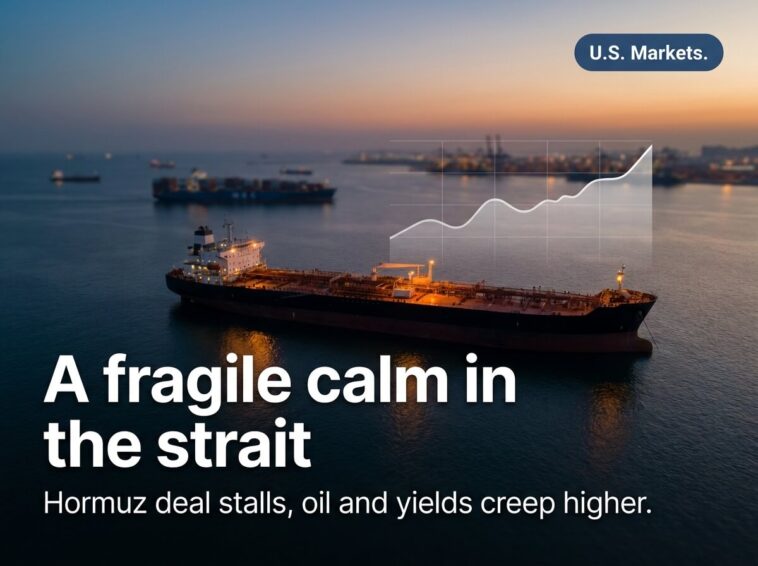
The Strait of Hormuz Deal Just Hit a Snag. Markets Barely Noticed. For Now.
The Strait of Hormuz saga isn’t over. Iran said Sunday a deal with Oman on transit through the waterway is in its “final stages.” Then came the catch. Tehran reiterated the U.S. still has to meet several conditions first before the strait reopens.
Translation: close, but not done. Oil rose 3.5% Monday morning on the uncertainty. Treasury yields, which had fallen Friday on weak jobs data, crept back up alongside crude.
And stocks? Barely blinked. The S&P 500 sat near a record high, up fractionally. The Nasdaq gained modestly. The Dow and Russell 2000 dipped slightly, both coming off record highs of their own just days earlier. This market just posted its best week since April, a 3.6% gain, and Monday’s Hormuz hiccup wasn’t enough to spoil the mood.
That resilience is either encouraging or concerning, depending entirely on what happens next.
Why the Strait of Hormuz Still Controls the Whole Macro Story
Here’s the thing about a chokepoint that carries roughly a fifth of the world’s oil supply. Every headline about it moves markets, whether the news is actually resolved or just rumored to be close.
“We’ve watched this exact pattern for weeks now. A hint of progress on Hormuz, oil dips, yields ease, stocks rally,” said Marcus Thorne, Head of Macro Strategy at a New York boutique advisory firm. “Then a condition attached, a demand unmet, and oil creeps right back up. Monday’s move is small in isolation. But it’s the fourth or fifth time this summer traders have gotten excited about a deal that then stalls on some fine print. At some point, the market needs to stop pricing in resolution and start pricing in stalemate.”
He’s onto something. This entire market cycle since June has traded on a rotating cast of macro anxieties, Iran, oil, Fed policy, AI capex, and each one gets partially resolved just long enough for the next one to take over. Friday’s rally came almost entirely from a weak July jobs report, nonfarm payrolls falling 23,000 against expectations for an 83,000 gain, which cooled fears of a near-term Fed rate hike. Monday’s Hormuz snag is already chipping at that optimism, just three trading days later.
The bigger test arrives midweek. CPI and PPI inflation data land Wednesday and Thursday, the first real inflation reads since Friday’s soft jobs number scrambled rate expectations. If inflation comes in hot at the same time oil’s climbing on Hormuz uncertainty, the Fed’s path gets murkier fast, right after the market spent Friday afternoon celebrating a supposedly clearer one.
Sector rotation Monday told its own story too. Storage and IT hardware names got upgraded, with Morgan Stanley citing what one analyst dryly called “chipflation,” rising component costs accelerating enterprise spending rather than delaying it, as businesses rush to lock in capacity before prices climb further. That’s a subtle inflation signal sitting inside a sector upgrade, easy to miss if you’re only watching headline indexes.
The Skeptic Who Says Hormuz Headlines Don’t Deserve This Much Attention
Not every strategist thinks the market’s tracking the right variable, though.
“We’ve spent two months treating every Hormuz headline like a market-moving event, and honestly, the price action barely justifies it anymore,” countered Elena Voss, senior equity strategist at a Chicago research shop. “Oil’s up three and a half percent this morning. The S&P is basically flat. That’s not a market panicking about energy supply. That’s a market that’s grown numb to this specific storyline and is genuinely more focused on Wednesday’s CPI print and this week’s remaining earnings, Cisco, CoreWeave, Super Micro. Hormuz matters at the margins. It’s stopped being the main event.”
Voss has a fair read on the price action itself. Monday’s modest, mixed index moves don’t scream crisis. But “stopped being the main event” and “stopped mattering entirely” are different claims, and a genuine supply disruption at that chokepoint would test that complacency immediately.
What This Means for Your Portfolio
The lesson from Monday, and honestly from most of this summer, is about not overreacting to any single headline in either direction.
The Strait of Hormuz situation remains genuinely unresolved, not resolved-with-formalities-pending the way Sunday’s “final stages” language implied. That distinction matters for how you read oil-sensitive positions and inflation expectations heading into Wednesday’s CPI data. A market that’s rallied 3.6% in a week on rate-cut hope is vulnerable to a hot inflation print landing right as oil’s ticking higher again, a combination that could force a rapid repricing of just how much Fed flexibility actually exists.
The practical move for retail investors: don’t let one soft jobs report convince you the rate path is settled, and don’t let one stalled Hormuz update convince you a supply shock is imminent either. Watch Wednesday and Thursday’s inflation data as the real tiebreaker. If CPI comes in cool despite oil’s uptick, Friday’s rally gets validated and this week likely extends it. If CPI runs hot, the market’s entire recent rationale, weak jobs equals dovish Fed, gets a much harder test, right as energy costs are adding pressure from a separate direction entirely.
Keep position sizing modest into a week that’s stacking inflation data on top of an unresolved geopolitical chokepoint. This market has proven all summer that it can shrug off one macro headline. Stacking two at once, particularly if they point the same direction, is a different story.