Editor
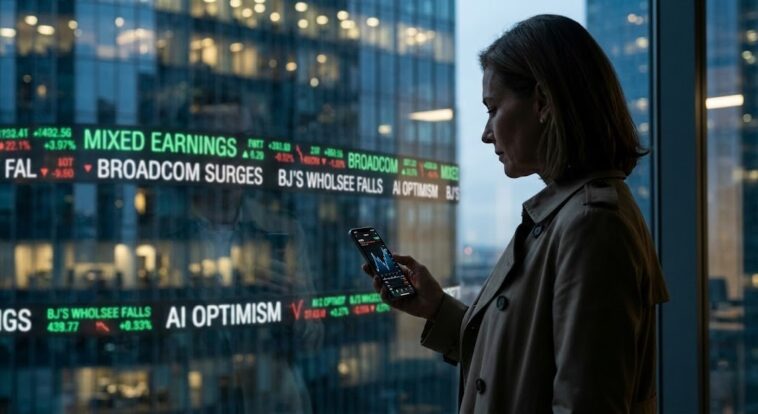
Mixed earnings results dominated the tape on Thursday as Wall Street wrestled with a stark divide between the relentless momentum of the artificial intelligence trade and a increasingly cautious consumer landscape. While chipmakers and ad-tech firms found new gears, established retail names discovered that “good enough” is no longer sufficient to satisfy a nervous market.
The AI Engine Roars On
If there was any doubt that the AI gold rush has staying power, Broadcom silenced the skeptics. The semiconductor heavyweight saw its shares jump 6.4% after posting a 29% year-over-year revenue surge. It wasn’t just a beat on the top and bottom lines; it was the forward-looking guidance that caught the eye of institutional desks.
“Broadcom isn’t just riding the wave; they are building the surfboard,” says Elena Vance, Chief Equity Strategist at Vanguard Global Insights. “When you see $19.31 billion in revenue against a sub-$19.2 billion estimate, it tells you the enterprise appetite for high-end silicon is nowhere near a ceiling.”
Adding fuel to the tech fire, The Trade Desk saw a massive 19% pop. The catalyst? Reports that OpenAI—the poster child for the current tech epoch—has held preliminary talks with the company regarding ad sales. It’s a move that suggests the intersection of LLMs (Large Language Models) and digital advertising is moving from theory to reality.
Retail’s Guidance Gap
The mood was decidedly more somber in the aisles of BJ’s Wholesale Club. Despite beating expectations for the fourth quarter, the warehouse giant saw its stock shed 4.5%. The culprit was a lukewarm full-year outlook that fell short of the consensus $4.66 per share.
It’s a pattern we’re seeing across the board: investors are discounting past performance in favor of a microscopic look at future margins. Burlington Stores managed to buck this trend, gaining 7% after a robust double-beat, but American Eagle found itself in the red despite growth in its Aerie brand—a sign that “decent” is the new “disappointing.”
“The market is being incredibly punitive toward anything that smells like a slowdown,” notes Marcus Thorne, a veteran floor trader. “BJ’s put up solid numbers, but the moment they whispered about a softer year ahead, the trap door opened. It’s a tough crowd out there.”
Security and Infrastructure Under the Microscope
The enterprise sector showed flashes of resilience. Veeva Systems skyrocketed 10% on a stellar fourth quarter, while identity security firm Okta eked out a 1.5% gain after clearing Wall Street’s bar.
However, the “green” trade continues to face friction. ChargePoint slipped 2% after missing revenue targets, highlighting the ongoing growing pains of the EV infrastructure build-out. Similarly, Ciena dropped nearly 4%—a surprising move given their beat, but perhaps a natural “sell the news” event after the stock’s meteoric 350% rise over the last twelve months.
Global Shifts and Berkshire’s Confidence
Across the Pacific, JD.com’s U.S.-listed shares dipped following its first quarterly loss in nearly four years. The 2.7 billion yuan hit served as a cold reminder of the persistent headwinds facing Chinese e-commerce.
Closer to home, the “Oracle of Omaha” is signaling value. Berkshire Hathaway Class B shares rose over 1% on news of the first share buybacks since 2024. Perhaps more telling was CEO Greg Abel’s personal $15 million stake increase. In a market defined by volatility, a vote of confidence from the top of Berkshire still carries significant weight.
The Bottom Line
As the dust settles on this latest round of reporting, the narrative is clear: the AI “haves” are widening the gap over the traditional “have-nots.” For investors, the coming weeks will be a test of whether the tech-heavy momentum can offset the creeping fatigue in the retail and consumer sectors.