Editor
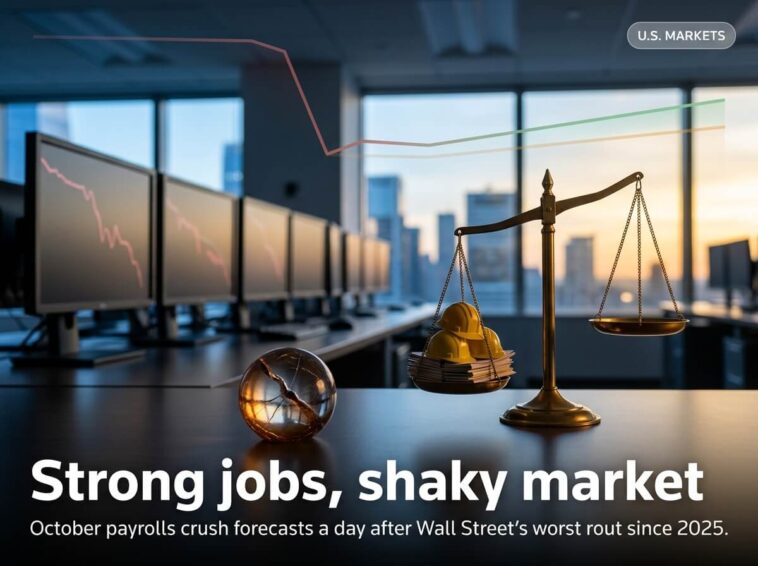
Jobs Report Crushes Forecasts a Day After Wall Street’s Worst Crash Since 2025, and the Fed Gets More Room to Hike
The October jobs report arrived Friday morning, and it landed on a market still reeling. Strong news. Awkward timing.
Employers added 165,000 jobs last month, the Labor Department said. Economists had expected somewhere between 59,000 and 65,000. The unemployment rate slipped to 4.1% from 4.2%. Private payrolls rose 159,000, and government added 6,000. Average hourly earnings climbed 0.4% on the month and 3.1% from a year earlier, beating forecasts of 0.3% and 2.9%.
The revisions mattered too. August was raised to 186,000 from 133,000, and September jumped to 60,000 from an initial 29,000. Together, they added 84,000 jobs to the summer. A month ago, the labor market looked limp. Now it looks sturdy.
Professional and business services led with 70,000 new jobs. Health care added 42,000, and transportation and warehousing added 25,000.
But Thursday’s wreckage hasn’t gone away. The Nasdaq Composite fell 5.52% to 24,315.00, closing in correction territory. The S&P 500 dropped 4.36% to 7,353.73. The Dow lost 1,833 points, or 3.44%, to 51,523.06. All three had their worst day since April 2025. The Nasdaq 100 sank 6.36%, its worst session since March 2020, and the semiconductor index fell about 12%. Roughly $2.3 trillion to $2.5 trillion in market value vanished.
Nvidia lost 9.3% and erased all its 2026 gains. Broadcom fell about 10%. All 11 S&P 500 sectors finished lower, and the VIX jumped to its highest since March. Fear that Democratic midterm gains could slow the AI data-center buildout drove the rout, along with Qualcomm’s weak forecast.
What the October Jobs Report Means for the Fed
Strong jobs. Hot inflation. Cornered Fed.
The Fed raised rates in September, and two officials dissented last month in favor of going further. Markets already expected another hike in December. After this report, those odds rose to about 77%, according to CME Group’s FedWatch tool, though traders still see only one more increase after that.
Treasury yields jumped. The 10-year yield rose to roughly 4.87% to 4.89%, up between 3 and 6 basis points. The 2-year climbed nearly 5 basis points to 4.52%, and the 30-year rose to about 5.28%.
Read the curve. The 2-year yield, which tracks Fed expectations, sits well above the top of the central bank’s 3.75% to 4% range. That gap says traders expect more hikes. The 10-year sits about 35 basis points higher, which keeps the curve upward sloping. It’s not signaling recession. It’s signaling tight money for longer.
This is why good news can be bad news for stocks. A strong job market gives the Fed room to keep fighting inflation, which has been running hot because of oil. Higher rates hit growth stocks hardest, since their profits arrive years from now.
“This report closes the door on the idea that the labor market is cracking,” said Rafael Quintero, chief economist at a Midtown Manhattan research firm. “Hiring rebounded, wages picked up and revisions were generous. If you’re a Fed official worried about inflation, this is the green light. December is firmly in play.”
The Counter-Narrative: The Crash Could Slow the Fed
Not everyone expects a hike.
“The Fed doesn’t hike into a market that just lost two and a half trillion dollars,” said Priscilla Dunn, a macro strategist at a Boston asset manager. “Wealth effects matter. Financial conditions have tightened sharply in two days. And there are cracks in this report. Long-term unemployment is climbing. I think they hold in December and say they’re watching.”
She has a point about the cracks. The average duration of unemployment jumped to 27.1 weeks, the highest since September 2021. The broader U-6 underemployment rate rose to 7.9% from 7.6%. Hiring is strong on the surface, but some workers are stuck.
Still, the Fed has said inflation is its focus. One bad day for stocks rarely changes that.
What Retail Investors Should Do Now
None of this is personal advice. It’s a checklist.
First, don’t act on a single day. Thursday was one of the worst sessions in years. Selling out after a crash locks in losses. Buying blindly into it ignores the risk of more. A plan you set in calm conditions beats a reaction in a panic.
Second, understand “good news is bad news.” Strong data can push yields up and stocks down at the same time. When the Fed is the main worry, jobs numbers matter as much as earnings.
Third, check your tech exposure. Nvidia and other chip names now make up a big slice of many funds. Open the top holdings of each fund you own and look for overlap.
Fourth, look at short-term Treasuries. With the 2-year near 4.5%, bills and short notes pay a solid return with far less price swing than stocks. Check current rates before buying.
Fifth, avoid leveraged funds. Products that double or triple daily moves can do serious damage in weeks like this one.
Sixth, rebalance gradually. If the crash left your stock share below your target, add back in pieces over weeks, not hours.
Seventh, keep a cash buffer. Volatility is high, and a cushion keeps you from selling at the wrong time.
What Comes Next
Asian markets tumbled Friday after Thursday’s Wall Street rout, with one benchmark falling almost 9% at the open and triggering a 20-minute trading halt, according to CNN. Futures swung around the jobs release, so Friday’s close will matter. The next inflation report and December’s Fed meeting come next.
The Fed’s stance? Hawkish, and now with the data to back it. The market’s stance? Shell-shocked. The jobs report said the economy is strong. The crash said the AI trade is fragile. Both can be true at once.