Editor
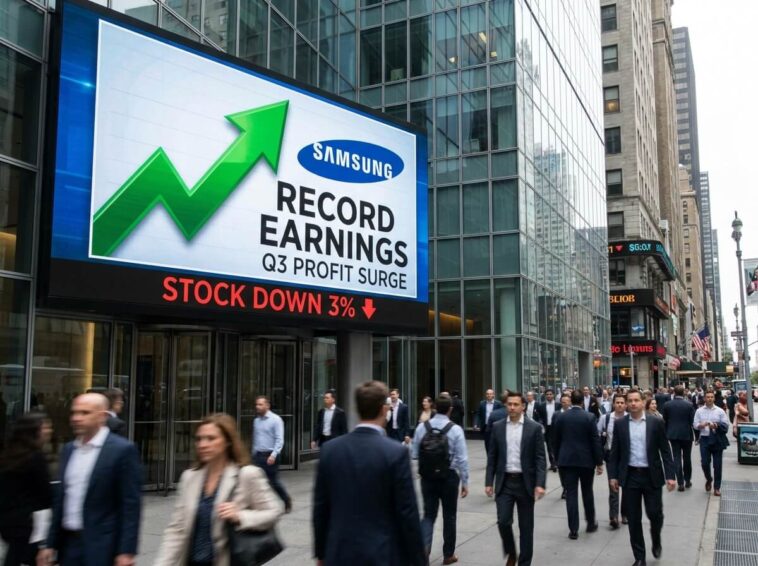
Samsung Earnings Were Great. Wall Street Sold Them Anyway.
Samsung earnings landed Tuesday, and the numbers were almost absurd. Operating profit up roughly 1,800% year-over-year. A nearly 19-fold jump in quarterly income. The kind of print that should send a stock soaring.
Instead, Samsung shares fell nearly 7% in Seoul. The Kospi got dragged down almost 5%, so hard that Korean exchange officials tripped a circuit breaker, freezing trading for twenty minutes. Eight percent down at the worst of it.
Good news. Terrible reaction. That gap tells you everything about where this market’s head is right now.
The Samsung Earnings Reaction Nobody Saw Coming
Traders didn’t sell because Samsung disappointed. They sold because Samsung’s blowout wasn’t blowout enough, relative to what the AI trade has been pricing in for months. Expectations got so extreme that reality — even spectacular reality — landed like a letdown.
“This is a classic sell-the-news event,” said Marcus Thorne, Head of Macro Strategy at a New York boutique advisory firm. “When a stock’s priced for perfection and then delivers merely excellent, that gap between ‘excellent’ and ‘perfect’ is where the selling happens. Samsung didn’t miss. The market’s expectations did.”
The pain spread fast. Micron dropped 7% in U.S. trading. Broadcom, KLA, Marvell, AMD — all lower. The VanEck Semiconductor ETF fell more than 5%, on top of an 8% slide the week before. Nvidia, the bellwether for the entire trade, slipped too, even after insisting days earlier that its roadmap remained intact.
Meanwhile the Dow Jones hit a fresh intraday record, above 53,000. Money didn’t leave the market. It just left chips.
The Skeptic Who Thinks This Rotation Is Healthy, Not Scary
Not every strategist reads this as trouble.
“People keep treating chip volatility like a warning sign for the whole market. It isn’t,” said Elena Voss, senior equity strategist at a Chicago research shop. “Look at where the money’s actually going — healthcare, financials, consumer staples. Eli Lilly’s up. JPMorgan’s up. Walmart just cut prices on groceries and got rewarded for it. That’s a market broadening out, not falling apart. If anything, this is healthier than everyone piling into six chip names forever.”
Voss has a case. The VIX, Wall Street’s fear gauge, sat around 16 — comfortably below the 20 threshold that usually signals real panic. A tanker incident near the Strait of Hormuz pushed oil prices higher too, adding a geopolitical layer to the day. Yet broader indexes barely flinched.
What This Means for Your Portfolio
Here’s the takeaway, and it applies well beyond Samsung.
Earnings don’t move stocks in isolation. Earnings move stocks relative to what was already priced in. A company can grow profit nearly twentyfold and still get punished, if the market had quietly built in expectations for something even bigger. That’s not irrational. It’s just how expectations-driven pricing works.
For a retail investor, the lesson is about watching the gap, not just the headline number. Before buying into an earnings report, ask what the stock was already assuming. If a name has run hard on hype heading into results, a “great” quarter can still trigger a selloff — because great wasn’t the bar. Perfect was.
Sector rotation is doing real work here too. As chip valuations wobble, capital is finding a home in healthcare, financials, and old-economy retailers with real, current cash flow. That’s not abandonment of the AI story. It’s diversification, forced by a market finally starting to ask harder questions about price.
Watch the reaction, not just the report. Tuesday proved, again, that in this market, the two can be worlds apart.